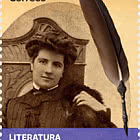
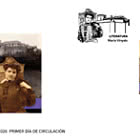
María Vinyals y Ferrés was born at Soutomaior Castle (Pontevedra) in 1875 into an aristocratic family. Her uncle-in-law, Antonio Aguilar y Correa, Marquis of La Vega de Armijo, introduced her at a very young age to Madrid’s leading cultural circles, while she spent her summers in Soutomaior. She received an excellent education, learned several languages, and began to explore writing and painting, participating in several National Fine Arts Exhibitions.
Pressure led her to burn her early writings and abandon her pursuit of the visual arts as soon as she married the Marquis of Ayerbe in 1896. Nevertheless, she returned to the world of literature and published, among other works, *El Castillo del Marqués de Mos en Sotomayor* (1904), a meticulous study of the history of the Sotomayor lineage and its castle, and the autobiographical novel *Rebelión* (1905), under the pseudonym Joyzelle. She served as president of the Ibero-American Center for Popular Women’s Culture, was a non-voting member of the Royal Galician Academy, and became a member of the Ateneo de Madrid.
1908 was a pivotal year because she was freed from all family pressures following the deaths of her uncle and her husband. A few months later, she married Enrique Lluria Despau, a Cuban doctor and intellectual, and they moved to Soutomaior Castle. They built Galicia’s first modern sanatorium, the Hotel-Sanatorio Lluria, which specialized in urinary tract diseases, and welcomed many of their friends to Soutomaior: Emilia Pardo Bazán, Joaquín Sorolla, Pablo Iglesias… In 1917, the castle was put up for public auction. The enormous debts they had incurred and both spouses’ membership in the Socialist Party did not help the project succeed.
María earned the nickname “Red Marquise” for her progressive ideas and her advocacy for women’s education, equal rights, and universal suffrage. Her journalistic work includes hundreds of articles on a wide variety of topics published in national and international newspapers and magazines between 1905 and 1935.
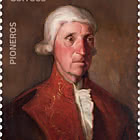
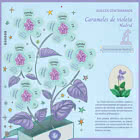
In 1920, she moved with her family to Cuba, but her life was cut short by her husband’s death five years later. She was plagued by financial hardship and illness, and we still do not know for certain when or where she died. In any case, María Vinyals was a pioneer in social activism, the arts, literature, and feminism, and her legacy is now being recognized with the issuance of this stamp.
Soutomaior City Council