Stecci
Stećci, stećak (sing.) or stećci (pl.) are medieval monolithic tombstones found on almost all the territory of Bosnia and Herzegovina, in the western parts of Serbia and Montenegro and in central and southern parts of Croatia. It is assumed they first appeared in the second half of the 12th century. They were most intensively hewed in the 14thand 15th century before gradually ceasing to be made in the 16th century. The systematic inventory resulted in the figure of around 70 000 registered tombstones at about 3300 sites on the territory of the mentioned states.
Stećci were mostly made of limestone – a most common type of stone in this region very suitable for carving. Quarries for quarrying stone for stećci were mainly located in the vicinity of cemeteries bearing in mind that those were stone blocks of up to several tons.
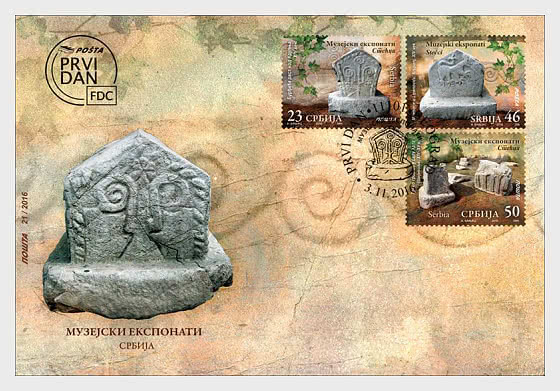
According to the shapes of stećci they are divided into five basic types with variations: slab, chest, sljemenjak (gabled roof stećak), monumental cross and pillar. Decorative motifs may be divided into several groups: social and religious symbols (different types of crosses, tools, weapons, new moon and stars, anthropomorphic lilies, solar motifs), figural compositions (images of men and women, animals, jousting scenes, tournaments, hunting, parades of people, so-called funeral wheel-dances) and numerous vegetal and geometric ornaments.
Stećci – Medieval Tombstones Graveyards in Bosnia and Herzegovina, Montenegro, Croatia, and Serbia were inscribed on UNESCO’s World Heritage List on July 15, 2016. The Republic of Serbia nominations are archaeological sites, Mramorje, Pеrućac and Mramorje, Rastište, (Bајinа Bаštа Municipality) and the Greek Cemetery in the Hrta Village (Prijepolje Municipality).
Motifs on stamps: face value 23 RSD: Tree of Life, Burđića rast near Krupanj 14th century; face value 46 RSD: Dragon, Mramorje in Lipenović, Krupanj, 14th century; face value 50 RSD: Arcades, the Greek Cemetery in the Hrta Village, Prijepolje Municipality, 14th to 15th century. Motif on the envelope: Tree of Life, Mramorje in Lipenović, Krupanj, 14th century.