Fauna
| Set |

| Set |

| Set |
| Set |
| Sheetlets |
| First Day Cover |
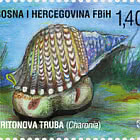
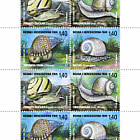
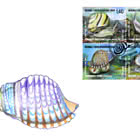
Triton’s trumpet and giant tun are the largest sea snails in the Adriatic Sea and stand for rare and protected species. The fusiform Triton’s trumpet (Charonia) has a large aperture and an oval operculum. It can weigh up to 1 kg, while its shell can reach over 50 cm in length. It feeds on starfish. Its name is associated with Greek god Triton, son of Poseidon, the god of the sea. The giant tun (Tonna galea) has a large and fragile barrel-shaped shell, pale grey-yellowish to brown in colour and a while body with black spots. It can reach 1.5 kg in weight and up to 30 cm in length. One of its rare characteristics is its luminescence ability. When moving through the water with its foot fully extended, it emits a greenish light.
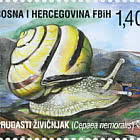
The Roman snail (Helix pomatia) is one of the largest land snails. It has a solid, globular shell cream-white or yellowish-brown in colour and about 4 cm high and wide. It has two pairs of slender, retractable tentacles on its head, and eyes at the tips of the longer pair. It has a large aperture from which the anterior part of the body protrudes. The banded snail (Cepaea nemoralis) is one of the most common land snails in Europe. Its shells can be white, yellow, brown or even black, and usually have one to five dark brown or black stripes. Sometimes these stripes merge into one or two broad bands, while in some cases they are completely missing.
(Željka Šaravanja)
Bosnia and Herzegovina - Mostar - Recommended stamp issues








WOPA+ recommended stamp issues

| Avatar - Fire and Ash |
| Issued: 03.12.2025 |
| ›New Zealand |

| 50th Anniversary of the Founding of the 24th November Bar Scout |
| Issued: 24.11.2025 |
| ›Montenegro |
| Krisjanis Valdemars |
| Issued: 02.12.2025 |
| ›Latvia |


| Sign Language - Good |
| Issued: 02.12.2025 |
| ›Bosnia and Herzegovina - Republic of Srpska |

| In Memory of the Fallen and Murdered on October 7, 2023 |
| Issued: 08.10.2025 |
| ›Israel |


| Annual Collection Folder (New York) |
| Issued: 05.12.2025 |
| ›United Nations |
| Year Set |
| Issued: 24.11.2025 |
| ›Isle of Man |
| Shipping in the 17th and 18th Centuries - Peat Shipping |
| Issued: 05.12.2025 |
| ›Netherlands |