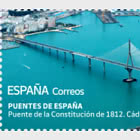
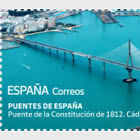
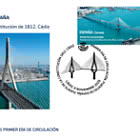
In 2025, Correos (the Spanish postal service) will release a stamp as part of its "Bridges of Spain" series, featuring the 1812 Constitution Bridge in Cádiz.
The cable-stayed bridge spanning the Bay of Cádiz, also known as the 1812 Constitution Bridge, is one of the most unique, large-scale, and complex projects undertaken by the Ministry in recent years. Indeed, 80% of the bridge's length is a bridge or viaduct.
This infrastructure provides a third access route to the city of Cádiz from the mainland and is 3,092 meters long, with 34 piers and two towers, nine of which are located in the sea. Furthermore, it is the second-highest vertical clearance (height from the deck above the waterline) of any sea bridge in the world, after the Verrazano-Narrows Bridge in New York, and ahead of the Golden Gate Bridge in San Francisco.
Regarding the bridge deck, four main sections can be distinguished:
• The Cádiz access viaduct, made of concrete and steel, is 581 m long and has a clearance of up to 75 m.
• The cable-stayed viaduct is the most unique part of the bridge, featuring a cable-stayed structure 1,180 meters long and a clear span between pylons of 540 meters, the longest in Spain and the third longest in Europe, after the Normandy Bridge in France and the Rion Antirion Bridge in Greece. The pylons are 185 meters high and serve as anchor points for the steel cables that support the deck. The vertical clearance under the deck is also exceptional, at 69 m, to allow the passage of large vessels.
• The removable section, which, when lifted by cranes, allows the passage of vessels with a clearance greater than 69 m.
• The Puerto Real access viaduct is a 1,182-meter-long concrete viaduct with a prestressed concrete deck cast in place.
It has two lanes in each direction for road traffic and a dedicated public transport platform, which will initially include two lanes reserved for buses.
The primary objectives of this infrastructure are to improve connections with the city center of Cádiz, integrate the historic center into the social and urban fabric of the Bay of Cádiz, and promote and consolidate the development of the Port of Cádiz, while also reducing the flow of heavy goods vehicles through the city center.