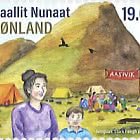
This series not only affords a visual insight into Greenland’s cultural history, but also acknowledges the rich heritage and many life stories found in these old photographs. Bringing ethnographic images to light builds a bridge between the past and the present and allows the viewer to reflect on Greenland’s cultural identity. The series comprises a combination of postal payment instruments, collector items, and a piece of vibrant cultural dissemination.
The series has been created in collaboration with Ina Rosing. Ina says of the series: ”I have tried to strike a balance whereby the colouring brings the photographs to life and evokes certain emotions – without dominating the very fine works themselves.
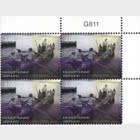
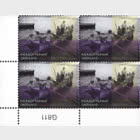
” We have reached the second part of the series ‘Ethnographic photographs from Greenland’. Both stamps are printed in offset on self-adhesive paper in sheets of 10 identical stamps.
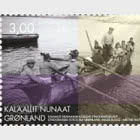
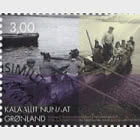
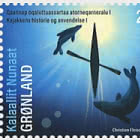
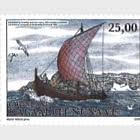
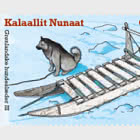
The ‘women’s boat’ photograph was taken in 1913 by Inger Bugge (1872 - 1954). She is known for her ’Diary of Journey to Godthaab, 1913’, which documents a trip to Nuuk and is stored as part of the archives at the Arctic Institute in Copenhagen. The material together with her diary writings afford a personal insight into colonial life and her experiences in Nuuk in the early 1900s.
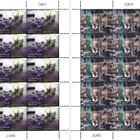
The photograph of the woman and the two children in a peat house was taken in 1926 in Ittoqqorttormiit. According to the Arctic Institute, the photographer is unknown. Based on dating of the photograph, it is reasonable to assume that the photograph was taken by either the polar explorer, ship’s master, author and inspector Ejnar Mikkelsen or a member of the group of people who settled in the area from 1924 – 25. Back then, the area was named Scoresbysund. Ejnar Mikkelsen and about 80 East Greenlanders, primarily from the Ammassalik region, settled the area at that time. Ittoqqoortoormiit was founded as part of Danish colonisation initiatives to secure sovereignty over NorthEast Greenland and to avail of favourable conditions for hunting and fishing in the area.