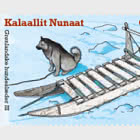
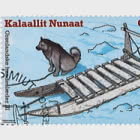
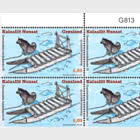
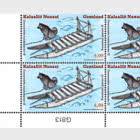
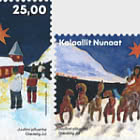
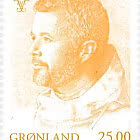
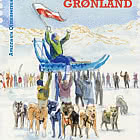
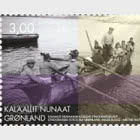
The series on Greenlandic dog sleds concludes with two stamps created by Konrad Nuka Godtfredsen, who has beautifully illustrated all six stamps in the series. The dog sled is a traditional, indispensable means of transport for the Inuit, built from animal materials such as whales, reindeer and seals and constitutes a unique symbol of Greenlandic culture and history, especially in North Greenland where it is still used for hunting and transport.
In 2024, we started by depicting the West Greenland dog sled, which is the longest of the three types. Last year we reproduced the East Greenland dog sled, which is probably the least known. We conclude the series with the North Greenland sled which, in many respects, resembles the West Greenland sled, but which also has clear differences.
The North Greenland dog sled is the smallest and lightest of the three types. It is very low and narrow and features a short sled surface. It is fast and manoeuvrable but with less load capacity. In North Greenland, the sled is typically pulled by 8 – 12 dogs, but there may be fewer. It is designed for extremely uneven terrain, pack ice and steep ice ridges. At the same time, it is easy to lift, turn and push over the cracks in the ice. The dogs are hitched to the sled by short lines, often very uneven in length. The dogs stand and run close to the sled in a narrow fan formation with a smaller lateral distance between the dogs compared to the other two types of sleds.