In mythology from all around the world, we find mythical animals with human features that communicate special messages.
The unicorn is often depicted as a white horse with a long, twisted horn on its forehead. It is therefore not surprising that the narwhal's long protruding tusk was once believed to be a unicorn's horn. The unicorn was pure and unadulterated - a symbol of purity and innocence and therefore only an innocent virgin could tame it.
The Phoenix has mythological roots back in ancient Egypt, where the sun was worshipped. The bird was described as a large eagle, very beautiful with feathers that shone with gold. It grew old, and when it died, it burst into flames and burned to ashes, only to rise again renewed. It is therefore not so strange that in the Middle Ages the Phoenix also came to symbolise Jesus Christ, who rose from the dead.
In Norse mythology, we find the legend of the Fenris wolf. The Nordic god Loki was its father and a giantess its mother. One of its siblings was the Midgard Serpent, which encircled the whole world. Like its siblings, the Fenris wolf was considered evil and dangerous by the Nordic gods. It was believed that the young wolf possessed hidden supernatural abilities that might later be useful to the Nordic gods. It grew quickly, and in order to control the wolf before it became too powerful, it was bound in chains. Twice it broke free from its chains. The gods then commissioned a dwarf, one of the finest blacksmiths they could find, to forge a third chain. It was thin as silk thread and was named Gleipnir.
The Æsir gods believed that the Fenris wolf could be held, and its special abilities used when the time was right. However, the wolf demanded assurance of the gods’ good faith, and required one of them to place a hand in its mouth as a pledge. It turned out to be the god Tyr, who took on this task. As soon as his hand entered the wolf's mouth, it began to fight with all its strength to break the chain but failed. Gleipnir held fast, but in the struggle the wolf bit off Tyr’s hand. Later, when the Fenris wolf finally broke free, it attacked and killed Odin during Ragnarok. One of Odin's sons, Vidar later avenged his father and killed the Fenris wolf with his sword.
The first settlers in the Faroe Islands brought with them Norse cultural heritage and knowledge of Norse mythology. They may also have known stories about the unicorn and the Phoenix. It is reasonable to believe that later Catholic priests were familiar of these mythical creatures and told tales about them.
The stories of Fafner, who guarded the gold at Gnita-heath and whom Sjúrður Sigmundarson stole from or killed, have been known in the Faroe Islands through the ring dance, where the ballad Sjúrðarkvæði was sung. This ballad about Sigurd Fafnirsbane has its motifs from German medieval ballads and legends, known as the Niebenlungenlied. A dwarf, Fafnir, suffered the misfortune of being bewitched into a dragon and tasked to guard his gold treasure at Gnita-heath. His brother, the dwarf and blacksmith Regin, played a part in this. When Sigurd Fafnersbane set out to kill the dragon, he had Regin forge the sword that he would use to kill the dragon. The treacherous brother not only forged the sword but also wanted his share of the gold but also sought to acquire the dragon’s supernatural abilities. The way to obtain them was through the heart of the dragon, which he asked Sigurd to give him. When Sigurd skewered the heart, he himself was the first to eat it and thus he gained the dragon's ability to see and sense things that others could not. He also gave his wife a piece, granting her the same abilities. The treacherous brother, the blacksmith Regin received nothing, but began instead to drink the dragon’s poisoned blood. Sigurd then struck him down with a fatal blow, so that he died where he stood. Thus ends the story of the dragon Fafnir, though the ballad of Sigurd Fafnir’s Bane continues with many further dramatic events.
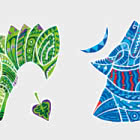
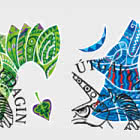
In his artwork, artist Edward Fuglø portrays these fabled animals in compositions marked by fragments and mosaics, echoing elements found in classical depictions and medieval manuscripts.
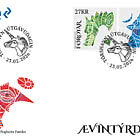
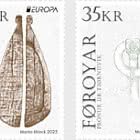
With these stamp images, the Faroe Islands now have their own representations of the Fenris wolf and Fafnir—the guardian of the gold at Gnita-heath in Germany—while the unicorn and Phoenix appear on the First Day Cancel and First Day Envelope, respectively.
Jóan Pauli Joensen