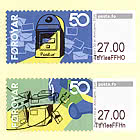
Famous Pilots in the Faroe Islands
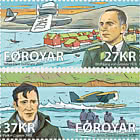
| Set |
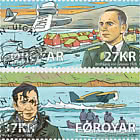
| Set CTO |
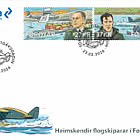
| First Day Cover |

| Stamp Booklet |

| Stamp Booklet CTO |
Wolfgang von Gronau – from Tvøroyri to New York in 1930
On the afternoon of Wednesday, 29 August 1928, shouts could be heard throughout Tvøroyri. The children initially thought the adults were calling for a whale hunt, so they all cried “grindaboð” (pilot whale alarm). But they quickly realized that the adults were not looking out to sea, but up into the sky—where an aircraft appeared over the fjord.
At the controls of the Dornier Wal seaplane was the German aviator Wolfgang von Gronau. He and his crew had flown directly from the island of Sylt in West Frisia, a journey that had taken eight hours. The Dornier Wal was one of two aircraft that Norwegian polar explorer Roald Amundsen had planned to use for his 1925 North Pole expedition, but he had to abandon the plan when the other aircraft was damaged on the ice.
Wolfgang von Gronau was the second pilot to visit the Faroes, after the Italian Locatelli. He visited the islands four times between 1928 and 1931 and became good friends with many people in Tvøroyri.
He returned to Tvøroyri the following year, but the stopover was brief. Von Gronau had fuel stored at Sevmyri by the river Húsagarðsá, where they refuelled so they could continue to Reykjavík.
At that time von Gronau said that he expected transatlantic flights via the Faroes and Iceland to become a reality within 2–5 years. This pleased the people of Suðuroy, who by then were highly enthusiastic about aviation and already leaders in Faroese business life.
First Flight Between Europe and the USA
On 1 August 1930, von Gronau returned to Trongisvágsfjørður, this time staying in Tvøroyri for a full day. He planned to continue to Reykjavík and stay there for two days.
“We will then return here to Tvøroyri and fly home again to Germany via Bergen,” von Gronau told his friends in Tvøroyri. However, von Gronau did not return.
In secret, he had been working on a plan to become the first to fly all the way from Europe to America, even though the authorities had made it clear they did not support such an attempt.
On the way from the Faroes to Reykjavík, he landed at Seyðisfjørður and from there sent a telegram home to the ministry in Berlin:
“Fliegen, Ihre Zustimmung vorausgesetzt, über Island nach New York!” – “Flying, provided you consent, from Iceland to New York!”
On 26 August 1930, the Dornier Wal D-1422 landed on the Hudson River in New York after 47 hours of flying with several stopovers.
A huge crowd gathered there and celebrated him, as they did in the streets of New York. He was also received by President Herbert Hoover at the White House.
When von Gronau returned to Germany, he was invited to meet Hindenburg, Marshal and President of Germany, who wanted to honour him on behalf of the German people.
Journey Around the Globe
The fourth and final time von Gronau visited the Faroes was in 1931. He stayed, as usual, with Josefine Mortensen, widow of the shipowner and merchant Niels Juel Mortensen, who hosted the whole crew for dinner. It is said the mood was very cheerful that evening, with von Gronau telling of his secret journey to America the year before and his experiences there.
He said nothing, however, about his next plan - a flight around the world. On 22 July 1932, he departed from List on Sylt and headed west. This time he bypassed the Faroes and made his first stopover at Seyðisfjørður. From there the journey continued to America, then via Alaska to Tokyo. The crew and aircraft visited various places in Asia and the Middle East, and after nearly four months circling the globe, they landed back near Berlin on 9 November.
The pioneer of German aviation was appointed Lieutenant Colonel in the Luftwaffe in 1936, and from the summer of 1939 he served as air attaché at the German embassy in Tokyo, Japan.
Wolfgang von Gronau returned to Germany in 1947. He settled in Frasdorf in Upper Bavaria, where he lived until his death in 1977.
Parker Cramer
While von Gronau was achieving fame for his transatlantic flight, another aviator, Parker Cramer, was attempting a similar North Atlantic route.
In the early 1930s, there was already fierce competition over who would first establish an air route between America and Europe.
Aircraft were small at that time, so the focus was on securing the lucrative airmail contracts. These could generate huge profits, since 4½ million letters were sent daily between America and Europe, providing an income of 1½ million Danish kroner per day.
The American company Trans-American Airlines Corporation proposed a route from Detroit, USA, to Copenhagen, via Greenland, Iceland, the Faroe Islands, and Shetland.
One of the strongest advocates for the North Atlantic route was the well-known aviator Parker Cramer, who held a high position in the U.S. aviation service.
Cramer Forced to Land Near the Faroes
Cramer had tried before, but luck was not on his side. In 1928 he was forced down on the sea off Kangerlussuaq in Greenland and lost his plane there. He came to Copenhagen by ship. In 1929 he had not even left the American mainland when he was again forced to abandon his plan to fly to Europe.
On 27 July 1931, Parker Cramer made his third attempt to fly from Detroit to Copenhagen. Newspapers reported that he would make an intermediate landing in the Faroes, and he was expected both in Tórshavn and in Tvøroyri.
Cramer and his mechanic, Paquette, visited six places before setting course for Sisimiut in Greenland. From there they flew to Ammassalik in East Greenland, becoming the first to fly across the Greenland ice cap.
Next, they flew to Reykjavík, arriving safely on 6 August. The following day, at 3 p.m., they took off again, announcing their plan to land in Trongisvágsfjørður by Tvøroyri, where they had stored fuel. They were expected between 8 and 9 p.m. but did not arrive.
Between 7 and 8 p.m., Tórshavn radio had telegraphic contact with the aircraft, which requested a position fix. But a ship’s transmission interfered, and the connection broke.
When contact was re-established, they reported they were forced to land immediately on the sea due to engine trouble. Cramer added that it would not be possible to maintain radio contact while the aircraft was floating on the sea.
Cramer expected to get the engine repaired quickly and continue as planned. Since they had not given their exact position, no ship could be sent to help, but it was assumed they were close to the Faroes, and ships were asked to keep watch.
The First Airplane in Vágur
At 9 p.m., a British trawler reported sighting a black aircraft with yellow wings flying toward Suðuroy. By 10 p.m. news came from Vágur that a plane had landed in the fjord. It had come down for unknown reasons a little way from shore and was towed in by a motorboat.
This was the first time such a guest had visited the village of Vágur. The aircraft was immediately surrounded by boats, the pier was packed with people, and the aviators were warmly welcomed. They explained that they had been forced to land because the oil pump had failed, but they had managed to repair it.
Cramer and Paquette stayed with the parish chairman, Petur Dahl á Gørðum. Early Saturday morning they began working on the engine and carrying out necessary repairs.
They had planned to depart the Faroes at 3 p.m., but were not ready until 5 p.m. They then headed to Lerwick in Shetland, arriving safely after a two-and-a-half-hour flight.
Cramer Disappears
The next day, Sunday 9 August, Cramer planned to fly the entire stretch from Shetland via Bergen to Copenhagen. He was in a great hurry that morning and did not wait for the latest weather reports, departing at 10 a.m.
News of this was sent at once to Copenhagen, where he was expected at 5 p.m. A large crowd gathered at Kastrup, to welcome Cramer and Paquette. They waited long and anxiously, but he never came, nor was he ever heard from again.
Shortly after leaving Lerwick, he ran into severe storms. Tjaldur, the Faroese passenger and cargo ship, then in the North Sea on its way to the Faroes, overheard Cramer in radio contact with Norwegian stations, but he soon fell silent.
The last confirmed contact was at 12:30 p.m. The storm that Sunday was so violent that Tjaldur was delayed 16 hours on her voyage, and many experienced sailors said they had never seen such a tempest.
Much speculation followed. Some thought the oil pump had failed again, proving fatal in the storm. Others believed they had turned back but failed to reach Lerwick.
The Norwegian ship Sjóglimt from Haugesund reported at 4 p.m. seeing a body floating in the sea near Shetland. They believed it was an aviator, poorly dressed, but could not bring it aboard due to the weather.
Some still hoped—another missing aviator had earlier been presumed dead but was later found alive on a remote island. This led Cramer’s brother to travel to Europe to search the North Sea and surrounding areas, but he found neither his brother nor the plane and soon gave up.
In late September, however, the British trawler Lord Trenton, sailing between Leith and Aberdeen, reported finding the wreckage of a badly damaged aircraft, which proved to be Cramer’s.
In a briefcase, they found a watch stopped at 1:30 p.m. This was the last trace of Parker Cramer and his ill-fated flight from Detroit to Copenhagen.
Magni Arge
Faroe Islands - Recommended stamp issues




WOPA+ recommended stamp issues


| Avatar - Fire and Ash |
| Issued: 03.12.2025 |
| ›New Zealand |
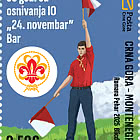
| 50th Anniversary of the Founding of the 24th November Bar Scout |
| Issued: 24.11.2025 |
| ›Montenegro |
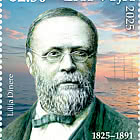
| Krisjanis Valdemars |
| Issued: 02.12.2025 |
| ›Latvia |


| Sign Language - Good |
| Issued: 02.12.2025 |
| ›Bosnia and Herzegovina - Republic of Srpska |

| In Memory of the Fallen and Murdered on October 7, 2023 |
| Issued: 08.10.2025 |
| ›Israel |



| Annual Collection Folder (New York) |
| Issued: 05.12.2025 |
| ›United Nations |

| Year Set |
| Issued: 24.11.2025 |
| ›Isle of Man |
| Shipping in the 17th and 18th Centuries - Peat Shipping |
| Issued: 05.12.2025 |
| ›Netherlands |