In the mid-12th century, the Count of Barcelona, Ramon Berenguer IV, offered some land in Conca de Barberà (Catalonia) to the Cistercian monks of the monastery of Fontfreda, near Narbonne, to found a monastery. In 1153, the community of Poblet was fully established, with its first abbot. Construction soon began.
The fact that the founding land was donated by the House of Barcelona determined part of the abbey's historical destiny: its future status as a royal monastery and its later conversion into the official pantheon of the counts of Barcelona and kings of Aragon.
Without monks since 1835 and plundered, Poblet began to be protected as a monument in the mid-19th century and especially since 1930, when a trust was founded to promote its restoration. Finally, in 1940, a small group of Italian Cistercians restored monastic life, which continues to this day.
As a whole, Poblet is a medieval complex unique in Europe, as it has all its monastic buildings intact and is also enriched by the royal buildings and pantheons, rounded off by the wall with its two noble towers at the entrance.
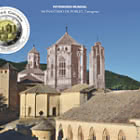
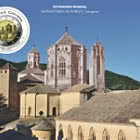
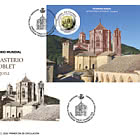
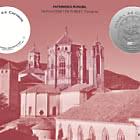
For the intaglio block sheet, a view of the eastern part of the monastery has been chosen, showing the apses of the 12th-century church, the large 13th-century dormitory, and the 14th-century wall surrounding the monastery.
The seal shows the evolution of different styles in the monastery. From right to left: the 12th-century Romanesque bell gable, the 14th-century Gothic lantern tower, the 17th-century bell tower, and the 18th-century Baroque sacristy lantern.
Monastery of Santa María de Poblet. Tarragona