The church of San Salvador de Priesca is located in the rural village of Priesca, in the municipality of Villaviciosa, and is one of the most important examples of Asturian Pre-Romanesque architecture. It was consecrated in 921 and was part of an ancient monastery that served as the religious center of a large territory. Its historical importance is reinforced by its early connection to the Coastal Way of Saint James, declared a World Heritage Site in 2015, and by the fact that the temple continues to be used as a parish church today.
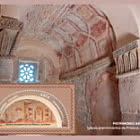
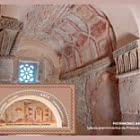
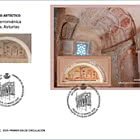
The building follows the basilica model characteristic of Asturian architecture, with three naves separated by arches on square pillars, a tribune at the western end, and an original gabled wooden roof. The chevet is tripartite, with vaulted chapels, and above the central apse there is a small raised chamber, accessible only from the outside. Of particular note are the sculptural decoration of the capitals and the exceptional set of preserved mural paintings, with geometric, architectural, and figurative motifs linked to early medieval iconography and the Beatus manuscripts.
Over the centuries, the temple underwent various transformations, especially during the Baroque period, as well as significant damage during the Civil War, which seriously affected the roof and paintings. After being declared a National Monument in 1913, various restoration projects were carried out, some with irreversible consequences.
The most recent work, completed in 2025 under the direction of the Spanish Cultural Heritage Institute, has enabled the comprehensive conservation of the interior's wall coverings and paintings, following criteria of minimal intervention and respect for historical and artistic values. This work has also led to the discovery of a unique early medieval frieze depicting horses facing each other, which reinforces the exceptional nature of San Salvador de Priesca within Asturian historical heritage.