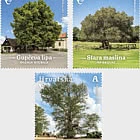
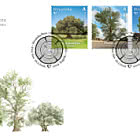
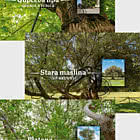
Gubec Linden Tree in Gornja Stubica
The large-leaved linden (Tilia platyphyllos Scop.), from the mallow family (Malvaceae), is a deciduous tree with a branched crown that can reach heights of up to 40 meters. Its bark is grey-brown, remaining smooth for a long time before becoming longitudinally furrowed and later cracked into transverse plates. The root system is deep and well-branched. The leaves are broadly heart-shaped with a short pointed tip and serrated margins, measuring 8 to 12 cm. The upper leaf surface is green, while the underside is lighter in color, slightly hairy along the veins, with white tufts of hairs in the vein axils. The large-leaved linden has yellowish-white, bisexual, highly fragrant flowers arranged in cymes of two to three flowers. It flowers in June, and after pollination, the flowers develop into round to oval nut-like fruits covered with dense grey hairs.
The large-leaved linden is monoecious (bearing both male and female flowers on the same plant) and entomophilous (adapted to insect pollination). It is a fast-growing species that can live up to 800 years. Its natural range includes Europe, western Asia, Crimea and the Caucasus.
The Gubec Linden Tree in Gornja Stubica has been protected as a natural monument – a rare specimen of its kind – since 1957. It is 9 meters tall, with a trunk circumference of 4.90 meters and a diameter at breast height of 1.57 meters. A living witness to the Peasant Revolt of 1573, it is traditionally believed to be the place where Matija Gubec gathered the rebels and began the struggle for peasant rights. The height of the tree was reduced from its original 30 meters to the present 9 meters due to a devastating storm in 1945. A lightning strike at that time created a cavity in the center of the trunk, while strong winds reshaped the crown into its present form. The tree’s current age is estimated to be over 450 years.
To ensure the preservation of this historic symbol, a project aimed at conserving its gene pool was launched. Thanks to joint efforts by civil society and experts, approximately 60 young saplings were produced by cloning the Gubec Linden Tree.
The Old Olive Tree on Brijuni
The olive tree (Olea europaea L.), from the olive family (Oleaceae), is an evergreen shrub or tree with a branched crown, growing up to 10 meters tall. The bark is grey-green and smooth until about the tenth year, after which it becomes knotted, wrinkled, deeply furrowed, and takes on a dark, almost black color, becoming firm and resistant even to decay. The olive tree’s root system is generally shallow, penetrating only 90–120 cm into the soil. The leaves are opposite, entire, leathery, ovate-lanceolate or elliptical in shape, with blunt or pointed tips, averaging 2–8 cm in length. The upper surface of the leaf is dark to light green, while the underside is silvery-grey. The flowers are small, bisexual, white-greenish in color, and appear clustered in panicles. During flowering, from April to June, they emit a characteristic fragrance. The fruit is a fleshy drupe, oval in shape, which begins developing in summer and reaches maturity around September, with some cultivars changing color from yellow or red to dark purple or black. Olive trees begin bearing fruit after seven years, with peak yields reached only after about twenty years.
The Old Olive Tree on Brijuni reaches a height of 6 meters and has a canopy diameter of 26 meters. Its age has been scientifically confirmed using radiocarbon (C14) dating. Analysis of a wood sample determined that the tree is over 1,600 years old, meaning it dates back to the Roman era. As one of the oldest olive trees in the entire Mediterranean, it is the sole remaining witness to what was once an extensive olive grove. The tree’s turbulent history is visible in its structure; particularly notable is a storm in the 1970s that caused the trunk to split into two parts. Despite its great age, the olive tree still produces around 30 kg of fruit each October, yielding approximately 5 liters of extra virgin olive oil.
Oriental Plane Tree in Trsteno
The Oriental plane tree (Platanus orientalis L.), from the plane tree family (Platanaceae), is a deciduous tree with an irregular, sparse crown, typically reaching heights of 30 to 40 meters. The bark is smooth and mottled in shades of brown and grey, peeling off in large patches; in old age, it becomes grey, plate-like and finely cracked. The root system is very strong and extensively branched, penetrating deeply and widely into the soil and ensuring the tree’s stability. The leaves are simple, alternate, thinly leathery, 10 to 30 cm long and wide, palmately divided into five, less commonly three or seven, sharp lobes that narrow at the base and have deeply and coarsely serrated margins. In autumn, the leaves turn brown or dark reddish-brown. The flowers are inconspicuous, unisexual, and arranged in hanging globular inflorescences. Flowering occurs in April, simultaneously with leaf emergence. The fruits are small, dry, inverted-cone-shaped nutlets with tufts of brown hairs at the base. They remain on the shoots throughout winter and disintegrate on the tree during the first warmer days of spring.
The Oriental plane tree is monoecious and heliophilous (light-loving) and can live for several hundred years. It grows rapidly and is often cultivated as an ornamental tree, valued for the shade it provides along roads and in urban parks. It is most commonly found in the Mediterranean and the Orient, and in Croatia, primarily in the coastal region.
The plane tree on the square in Trsteno has been protected as a monument of park architecture – an individual tree – by a decision of the Nature Protection Institute of the People’s Republic of Croatia dated 24 January 1951 (Official Gazette Nos. 80/19, 15/18, 14/19 and 127/19). It is 12.80 meters tall, and its age is estimated at just over 500 years. According to tradition, the plane trees were planted at the beginning of the 15th century by Captain Florio Jakob Antunov, known as Indian, who, inspired by the beauty of the Bosphorus plane trees during his travels, brought five saplings of the Oriental plane tree to Trsteno and planted them near a water source. To this day, only two monumental trees have survived, the plane tree on the square and one in a private garden, primarily thanks to the favorable climate, the nearby water source, and the care of local residents, who bequeathed responsibility for the trees to their heirs. Today, these two monumental Oriental plane trees represent a scientific and cultural link and are a symbol of Trsteno as well as of Croatia’s national natural heritage. They are among the largest plane trees in Europe and Croatia. Given their age, trunk dimensions and growth form, these two trees are unique specimens of their species even on a European scale.
Mirela Uzelac Božac, mag. oecol.
Assistant at the Institute of Agriculture and Tourism, Poreč