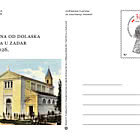
Definitive Stamps - Natural Beauties of Croatia
| Set |
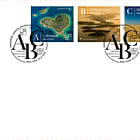
| First Day Cover |
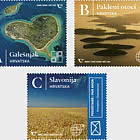
| Collectibles |

| Collectibles |
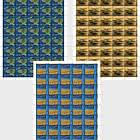
| Full sheets |
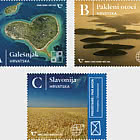
GALEŠNJAK
A heart-shaped island for the life-changing "Yes"
The Island of Love, the Island of Lovers, the Heart of the Adriatic... That is what they call the tiny island of Galešnjak in northern Dalmatia. Its heart shape, the most perfect one known, had only been noticed in recent times, in 2008 via Google Maps, and the world media and social networks made it a sensation overnight. Beyoncé celebrated her birthday there, Michael Jordan, Jeff Bezos and who knows what other celebrities visited the islet, and many couples have pledged their eternal love on Galešnjak.
Galešnjak is located near the coast, and it can be reached by taking the Adriatic road from Zadar some twenty kilometers to the south. In the Pašman Channel, not far from the coastal towns of Turanj, Sv. Filip i Jakov and Biograd na Moru, Galešnjak basks in the Mediterranean sun and awakens lovers' longing. Science says that it was inhabited in prehistoric times, about 7,000 years ago, but no one lives on it today, nor does it have any artificial structures. Only pebble beaches and crystal clear sea welcome romantics and anyone else who wants to step into this unique place. With an area of only 0.132 square kilometers, elevation of 36 meters above sea level and a coastline only a kilometer and a half long, Galešnjak is a favorite spot for those lucky people struck by Cupid's arrow.
Researchers have found traces of ancient graves there, as well as ages-old olive stones and a stone bridge undersea. Very long ago, when the sea levels were lower, Galešnjak was connected with the islet of Ričula, 80 meters away. Back in 1806, a Napoleon's cartographer accurately mapped the heart shape of Galešnjak, but it was viewed always from a human perspective, and it was only in our century that it became famous, thanks to modern technology. Whether arriving by an excursion boat, pedal boat or even swimming, just to relax on the beach or spend a night under the stars, or to seal the biggest decision of your life, Galešnjak will see you off with a blessing for all those who love, for all who live for – the heart.
PAKLENI OTOCI
Not hell, but heaven!
Pakleni or Paklinski otoci, for local people simply "Škoji", are a fairytale-like island group near the island of Hvar, not far from the town of Hvar itself. No, their name doesn't derive from the Croatian word for hell ("pakao"), nor the Paklenica National Park on Velebit mountain, rather they are named after "paklina", a type of pine resin used in shipbuilding. These twenty islets and reefs are a paradise for all lovers of the Croatian Adriatic, from less demanding tourists to scuba divers and sailing enthusiasts. The shores of Pakleni otoci are rocky and highly indented, the passages between some islets and cliffs are shallow, and some are not even navigable, so they are not recommended for boats in stronger winds.
The largest island of the archipelago is Sveti Klement. There are three settlements, as well as curious remains of a Roman villa, which was probably a site of minor ancient salt pans. Sveti Klement also features Palmižana, a sandy cove in the shade of old pines with an exotic botanical garden of the old Meneghello family. Generations of this family had been bringing unusual plants there, and a unique symbiosis of nature and art was created by the collector Dagmar Meneghello, who enriched the garden with numerous works of art. A truly special place! Therefore, it is no wonder that Pakleni otoci became protected as an important landscape as early as 1968. They are also part of the Natura 2000 ecological network due to the posidonia sea plant, their sandy bottoms permanently covered by the sea and their sea caves. With a climate with little precipitation and lots and lots of sunshine (it is said it snows there once every twenty years), Hvar and Pakleni otoci have long been an irresistible draw for tourists, and there is accommodation available as well.
The exceptionally clean sea and countless coves have made the beaches of these islands irresistible, and diving enthusiasts have long had their oases there. With 2718 hours of sunshine per year, they are indispensable to Croatia's tourism.
SLAVONIA
A golden history of grain fields and oak forests
Slavonia, along with Baranja and the Croatian part of Srijem, comprises eastern Croatia, a large, traditionally agricultural and culturally rich region. While facing many challenges in the new millennium, Slavonia has retained the title of the Croatian granary and the region where nature has been incredibly generous to people. The golden grain fields have often attracted people from the less arable, poorer regions to Slavonia, but also those with a strong entrepreneur spirit, in contrast to the sometimes easygoing and carefree natives of Slavonia. Even the storied forests of Slavonian oak, although they were mercilessly exploited by foreigners, are still there, and Slavonian oak is one of the noblest trees known to the world.
Always with Croatia in their hearts, on the frontlines against fierce enemies up until recent times, Slavonians work their fields even today, but they also excel in state-of-the-art technology, with many startups launched by their inspired innovators. Slavonia will offer its fields, forests, rivers and lakes to any tourist or visitor, but also its hills, almost a thousand meters tall, in the region's western part. With cultural events such as Zlatne žice Slavonije ("Golden Strings of Slavonia"), Vinkovačke jeseni ("Vinkovci Autumn Festival"), Đakovački vezovi ("Đakovo Folklore Festival") and many others, Slavonians boast a rich cultural heritage and colorful customs.
On the border between Slavonia and Baranja lies the Kopački rit Nature Park, and in western Slavonia the Papuk Nature Park. The former, in a corner between the Danube and the Drava rivers, is full of lakes, canals, ponds, forests, meadows and wetlands, and is one of the best-preserved floodplains in Europe. The most valuable part, however, is the zoological reserve with deer, a multitude of waterfowl and white-tailed eagle, a symbol of the Park. The wooded and hilly Papuk mountain, on the other hand, has a huge geological, biological and cultural diversity. There is also the Papuk Geopark, the first Croatian geopark, whose sites, such as Rupnica or the Geoinfo Center in Voćin, tell the a 600-million-year-old story of the planet Earth.
Hrvoje Dečak, mag. nov.
Croatia - Recommended stamp issues







WOPA+ recommended stamp issues

| Avatar - Fire and Ash |
| Issued: 03.12.2025 |
| ›New Zealand |
| 50th Anniversary of the Founding of the 24th November Bar Scout |
| Issued: 24.11.2025 |
| ›Montenegro |
| Krisjanis Valdemars |
| Issued: 02.12.2025 |
| ›Latvia |

| Sign Language - Good |
| Issued: 02.12.2025 |
| ›Bosnia and Herzegovina - Republic of Srpska |

| In Memory of the Fallen and Murdered on October 7, 2023 |
| Issued: 08.10.2025 |
| ›Israel |



| Annual Collection Folder (New York) |
| Issued: 05.12.2025 |
| ›United Nations |

| Year Set |
| Issued: 24.11.2025 |
| ›Isle of Man |
| Shipping in the 17th and 18th Centuries - Peat Shipping |
| Issued: 05.12.2025 |
| ›Netherlands |