Croatian Protected Agricultural And Food Products (C)
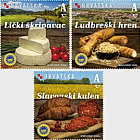
| Set |
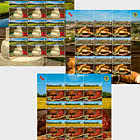
| Sheetlets |

| First Day Cover |
“SLAVONSKI KULEN” / “SLAVONSKI KULIN”
“Slavonski kulen” / “Slavonski kulin” is a shelf-stable dry sausage produced from a blend of the highest-quality cuts of pork, back fat, salt and spices, stuffed into a natural pork cecum casing and subjected to successive processes of fermentation, cold smoking, drying and aging for a minimum of 150 days. It is produced in the region of Slavonia, throughout Vukovar-Srijem County, Požega-Slavonia County and Brod-Posavina County, as well as in parts of Osijek-Baranja County, Sisak-Moslavina County, Bjelovar-Bilogora County and Virovitica-Podravina County.
The distinctiveness of “Slavonski kulen” / “Slavonski kulin” is based on its traditional production method and its physical and organoleptic characteristics. Historical records show that the production of “Slavonski kulen” / “Slavonski kulin” in Slavonia has a tradition spanning more than 200 years. Traditionally, it is made from the meat and back fat of heavy, mature pigs aged between 12 and 20 months. Only natural seasonings are added to the mixture: table salt, hot and sweet red paprika and garlic. The production of “Slavonski kulen” / “Slavonski kulin” has retained its seasonal character (each year from early November to late March) and its natural process of fermentation, mild smoking, drying and aging over several months.
The appearance of “Slavonski kulen” / “Slavonski kulin” is also distinctive. On the outside, the sausage is bound with characteristic twine and moderately smoked, while the interior features a harmonious mosaic of lean meat and fat particles in natural reddish and whitish hues. The aroma of mature “Slavonski kulen” / “Slavonski kulin” on the outside reflects smoke from hardwood, while the interior carries notes of fermented pork, paprika and garlic, with a mild smoky nuance. Its flavor is characteristic of fermented, aged pork, salty and spicy, without acidity or bitterness.
“Slavonski kulen” / “Slavonski kulin” is an integral part of Slavonia’s traditional heritage. In the past, it was considered a highly valuable product, offered to dear friends or presented as a gift to important guests. Since production was relatively limited, typically one sausage per pig, and household means were modest due to the small number of pigs slaughtered per household, “Slavonski kulen” / “Slavonski kulin” was reserved for special occasions such as holidays, family celebrations and gift-giving. Today, the practice of serving and gifting “Slavonski kulen” / “Slavonski kulin” is even more common, owing to increased production and greater purchasing power among the local population.
“LIČKI ŠKRIPAVAC”
“Lički škripavac” is a soft, full-fat cheese obtained by coagulating raw or pasteurized whole cow’s milk using rennet and a dairy starter culture, followed by separation of the whey. It is produced without aging and therefore has no rind. “Lički škripavac” has a soft, elastic texture and is cylindrical or rectangular in shape. Its surface is milky white and rindless; when cut, the paste is closed or contains a small number of mechanical openings formed by retained whey during shaping. Its flavor is milky and mildly sweet with moderate saltiness, and it is particularly recognizable for its characteristic squeak when eaten. Depending on the quality of the milk, the cheese retains this squeaky property for the first 5 to 7 days; it can be restored by immersing the original vacuum-sealed cheese in warm water. “Lički škripavac” is produced in the geographic region of Lika, within three administrative regions, primarily in Lika-Senj County, and to a lesser extent in Zadar County and Karlovac County.
“Lički škripavac” originated from the inability to transport goods from remote, snow-isolated villages in Lika to nearby towns due to long winters and roads blocked by snow and drifts. It is a specific regional product of a livestock-raising population that produced this cheese solely for its own sustenance, particularly during the long, snowy winter months characteristic of Lika. The cheese’s distinctive squeaky texture results from the high fat and protein content of the milk, itself a consequence of the specific feeding practices of cows in this area.
Beyond its everyday practical value in the lives of residents of the mountainous coastal hinterland and Lika, the production of “Lički škripavac” is a recognizable symbol of regional identity. Its reputation is reflected in numerous traditional economic, cultural and folkloric events through which the traditions, customs and cultural heritage of the Lika region are preserved and presented, with “Lički škripavac” featured as one of the symbols of Lika.
“LUDBREŠKI HREN”
“Ludbreški hren” is the root of a vegetable crop obtained through the cultivation of wild horseradish (Armoracia rusticana P. Gaertn., B. Mey. & Schreb.), which as an indigenous species and protected local variety grows exclusively within Varaždin County. It is a vigorous, robust plant with large upright leaves that can grow up to 150 cm (59 inches) in height. “Ludbreški hren” is characterized by its pungency, sharpness and refreshing flavor, and is consumed fresh, primarily as a side dish or accompaniment to meals. Its distinctive properties result from the interaction of environmental factors (climate, terrain, location) and traditional production methods and cultivation techniques.
“Ludbreški hren” is marketed from Christmas to Easter. The ability to offer fresh “Ludbreški hren” over such an extended period, particularly during the winter months, stems from the fact that the root remains outdoors in the field and is harvested gradually, most often from late October and throughout the winter while the plant is dormant. Skill in cultivating “Ludbreški hren” is essential, from preparing planting material to finishing the root for market. Specific practices during the growing season and the ability to recognize the optimal stage of maturity ensure a root of distinctive shape and sensory qualities. Leaving the crop in the field until late autumn is part of the heritage of local producers who, through the oral transmission of production techniques from generation to generation, seek to preserve this indigenous protected variety with all its defining characteristics.
Optimal climatic and soil conditions for horseradish cultivation in Varaždin County, together with specific cultivation technology and the expertise of producers, have led to a long-standing tradition of producing “Ludbreški hren” and to the product’s established reputation. The close connection between “Ludbreški hren” and its area of cultivation is evidenced by numerous references in local newspapers, as well as other available documents and publications. Various newspapers, gastronomic guides and magazines mention “Ludbreški hren” as a typical product of Varaždin County, attesting to its reputation built over time and its continuous presence in the region’s agriculture and gastronomy.
Croatia - Recommended stamp issues






WOPA+ recommended stamp issues

| Avatar - Fire and Ash |
| Issued: 03.12.2025 |
| ›New Zealand |
| 50th Anniversary of the Founding of the 24th November Bar Scout |
| Issued: 24.11.2025 |
| ›Montenegro |

| Krisjanis Valdemars |
| Issued: 02.12.2025 |
| ›Latvia |

| Sign Language - Good |
| Issued: 02.12.2025 |
| ›Bosnia and Herzegovina - Republic of Srpska |

| In Memory of the Fallen and Murdered on October 7, 2023 |
| Issued: 08.10.2025 |
| ›Israel |


| Annual Collection Folder (New York) |
| Issued: 05.12.2025 |
| ›United Nations |
| Year Set |
| Issued: 24.11.2025 |
| ›Isle of Man |
| Shipping in the 17th and 18th Centuries - Peat Shipping |
| Issued: 05.12.2025 |
| ›Netherlands |