Famous Croats (C)
| Set |
| First Day Cover |
| Full sheets |
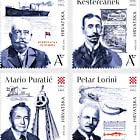
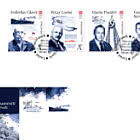
Petar Lorini (Sali, 1850 – Belgrade, 1921) was a prominent Croatian expert in marine fisheries and one of the founders of modern fishing on the eastern Adriatic. He completed Teacher Training School in Dubrovnik and a teaching course in Zadar, after which he worked in Korčula and Kotor. In 1873, he was appointed headmaster of the Public School in Sali, where that same year he introduced the Croatian language into teaching and municipal administration. He also introduced four-year schooling, which he opened to girls in 1885. In addition, he established and managed a post office. Lorini served as a commissioner of Matica hrvatska and contributed to the Croatian Encyclopedia (Osijek, 1887–1890). Alongside his work in education and municipal administration, he taught local fishermen and farmers viticulture and olive cultivation, and organized evening courses for adults on fisheries, agriculture, livestock breeding, beekeeping, sericulture, science and language, attended by around a hundred participants.
Lorini published professional articles in journals such as Zora, Smotra dalmatinska, Narodni list, Zadrugar and Gospodarski list, following global developments thanks to his knowledge of German, Italian and French. His exhibit Salted Fish received an award in Vienna in 1890 and the Grand Medal with Diploma at the Economic and Forestry Exhibition in Zagreb in 1891. After his service in Sali, he became a teacher at the Teacher Training School in Zadar in 1893. As a fisheries expert, he was appointed in 1897 as fisheries inspector for Dalmatia, the Austrian Littoral, Trieste and Istria within the Maritime Government in Trieste.
His ideas and innovations were presented in the book Fishing and Fishing Gear on the Eastern Adriatic Coast, which received a silver state medal at the International Fisheries Exhibition in Vienna in 1902 (while still in manuscript) and was published in 1903. It was the first Croatian book of its kind and served as a textbook in maritime schools. In it, he wrote his well-known thought: “The sea is a God-given field, which needs neither digging nor plowing nor sowing, but only wise harvesting.”
Lorini collaborated with Ivan Dellaitti to develop the first acetylene fishing lamp and later developed petroleum-based lighting, replacing wood. He also contributed to the construction of a fish processing factory in Sali (1905–1907), which significantly stimulated the development of the entire Dugi Otok area. In Sali, he conducted experiments in open-sea sardine fishing using a purse seine net of his own design, for which he received an honorary diploma in Koper in 1910.
On the centenary of his birth, a memorial plaque was placed on the house where he was born in Sali, the eastern quay of the town was named after him, and a bust by local sculptor Ante Orlić was installed in front of the school that has borne his name since 1973. Dr. Perica Cetinić of the Institute of Oceanography and Fisheries in Split wrote that Lorini “made a significant contribution to the development and advancement of Croatian marine fisheries and can therefore rightly be considered the founder of modern Croatian marine fisheries.”
Mauricij Frka Petešić
Mario Puratić (Sumartin, 1904 – Santa Barbara, USA, 1993) was a giant of Croatian and global maritime culture and history. Born into a modest family of fishermen and laborers in Sumartin on the island of Brač, he emigrated at an early age to the United States, where his creativity and vision made him a world-renowned inventor. The experience of hard labor on California tuna boats in the mid-20th century awakened Puratić’s innate spirit of invention, leading him to design a device for hauling fishing nets from the sea. Until then, nets were pulled manually, requiring extreme strength and endurance.
In 1954, his ingenuity and entrepreneurship led to the invention known as the Puretic Power Block (using the Americanized version of his surname). The Power Block is a pulley with a grooved rubber-coated wheel, designed to be suspended above the stern deck. Initially rope-driven and later hydraulic, it enables nets to be hauled with minimal human effort. This simple yet highly effective device, primarily intended for commercial fishing with purse seines, drastically reduced unloading time, decreased the number of crew needed and permanently eased fishermen’s work.
The Power Block was produced by the Seattle-based company MARCO (Marine Construction & Design Company), which further developed it in cooperation with the inventor. The use of the Power Block fundamentally transformed fishing and significantly increased its efficiency worldwide. On the Croatian Adriatic, the device, popularly known as purić, came into use in 1963, by which time thousands of vessels globally had been already equipped with it. Puratić received recognition for his contribution to the advancement of science and technology in the United States in 1975, when he was named Inventor of the Year, and he also became an honorary citizen of Iceland. The significance of his invention is reflected in the fact that, in 1972, Canada issued a five-dollar banknote depicting a fishing vessel equipped with a Power Block.
By the end of his life, he had registered more than twenty patents with the U.S. Patent Office, mostly related to improvements in fishing equipment. He died in Santa Barbara, but found his eternal resting place in the “beloved homeland”. Today, a stone bust of Puratić stands on the Sumartin waterfront, and the local Fisheries Interpretation Center “Kuća od 5 dolori” is dedicated to him.
Ida Jakšić, Museum Advisor
Ethnographic Museum Split
Federiko Glavić (Šipan, 1847 – Dubrovnik, 1941), a Dubrovnik shipowner and philanthropist, was one of the key figures in the maritime and economic life of Dubrovnik and beyond in the first half of the 20th century. After earning his capital through hard work in Chile, he returned home and invested not only in shipping (Dubrovnik Steam Navigation Company), but also in banking (Dubrovnik Commercial Bank, 1902), industry (Dubravka Paint Factory, 1924), trade and other sectors. He was not only one of the wealthiest men of his time in Dubrovnik, but it can be said without reservation that he was a visionary. When, in 1909, there was a threat that many Croatian shipping companies would relocate to Trieste and lose part of their national identity, Glavić strongly resisted and, through significant investment, ensured that the headquarters of the largest southern Adriatic shipping company remained in Dubrovnik.
As a young man, he emigrated to Chile (Iquique), where he invested his first capital in nitrate mines and became co-owner of a nitrate factory in 1886. He was an active member and once president of the Austro-Hungarian Mutual Aid Society for Croatian emigrants. In his new homeland, he also met his future wife, Maria Maldonado y Maldonado (1851–1942), who shared business interests with him. After spending a quarter of a century in Chile, Glavić returned to Dubrovnik in 1896 and embarked on diverse business ventures thanks to the earned capital. His role in maritime affairs was especially important as a principal co-owner of the Dubrovnik Steam Navigation Company. Glavić’s visionary moves once again ensured a new and independent business direction for Dubrovnik maritime affairs over the next half-century. His business partner was his nephew Tomo Glavić (1884–1979), who later expanded operations into tourism and hospitality before World War II.
Beyond their role in the economic history of Dubrovnik, the Glavić family also left a significant mark on Croatian architectural heritage through their commissions. Notable examples include Villa Dubravka in Pile (1902), Villa Orsula in Ploče (1919–1923), the annex of Hotel Argentina (1939), the conversion of Hotel Milinov into Hotel Dubrovnik in Zagreb (1940), and the mixed-use residential and commercial building of the Dubrovnik Steam Navigation Company (the so-called Ragusea) in Batala (1941). Federiko Glavić was also one of the great philanthropists of his time, supporting those in need in various ways and contributing to numerous initiatives. In his will, he bequeathed substantial sums to many cultural, educational and humanitarian institutions in Dubrovnik.
dr. sc. Ivan Viđen, graduate art historian and graduate archaeologist
Editor of the book Dubrovnik Shipowner Federiko Glavić
by dr. Aida Cvjetković
Fran Žaver Kesterčanek (Zagreb, 1856 – Zagreb, 1915) is one of the most important figures in forestry and hunting. During his dynamic career, he launched numerous activities in education, forestry administration and legislation, and wrote scientific and professional literature as well. He completed primary school and secondary education in Zagreb, graduating in 1874. Then he studied at the Forestry Academy in Mariabrunn and later at the University of Natural Resources and Life Sciences in Vienna, graduating in 1877. He was appointed a forestry trainee in Zagreb and later worked as a cadastral assessor. In 1878, he became an assistant at the Agricultural and Forestry College in Križevci, and in 1880 a lecturer in forestry. Kesterčanek advocated for reform of the institution and the transfer of forestry education to the University of Zagreb. As this idea was not accepted, in 1883, he left his teaching position in Križevci and took up the post of county chief forester in the Zagreb County administration. He returned in 1893 as a professor at the Agricultural and Forestry College in Križevci, continuing to advocate for the establishment of higher education in forestry in Croatia until the Forestry Academy was finally opened in 1898. He taught in Križevci until 1899, and in July 1900 he was appointed professor at the Forestry Academy.
As a member of the Croatian Forestry Society, Kesterčanek served as secretary, editor-in-chief of Šumarski listand director of the Forestry Museum. In 1891, he founded the Croatian Society for Game and Fisheries Management and also initiated the publication of its journal Viestnik, serving as its editor-in-chief for a full 18 years. He also authored the first Croatian manual on hunting, Lovstvo, published in 1896.
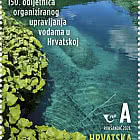
Alongside the analysis of F. Ž. Kesterčanek’s versatile contributions and the 170th anniversary of his birth, the following anniversaries are also particularly relevant: the 180th anniversary of the founding of the Croatian Forestry Society, of which he was a member and secretary; the 150th anniversary of Šumarski list, where he served as editor-in-chief; and the 130th anniversary of the aforementioned hunting manual Lovstvo, which he authored.
prof. dr. sc. Marijan Grubešić
University of Zagreb
Faculty of Forestry and Wood Technology
Croatia - Recommended stamp issues







WOPA+ recommended stamp issues


| Avatar - Fire and Ash |
| Issued: 03.12.2025 |
| ›New Zealand |
| 50th Anniversary of the Founding of the 24th November Bar Scout |
| Issued: 24.11.2025 |
| ›Montenegro |
| Krisjanis Valdemars |
| Issued: 02.12.2025 |
| ›Latvia |

| Sign Language - Good |
| Issued: 02.12.2025 |
| ›Bosnia and Herzegovina - Republic of Srpska |

| In Memory of the Fallen and Murdered on October 7, 2023 |
| Issued: 08.10.2025 |
| ›Israel |


| Annual Collection Folder (New York) |
| Issued: 05.12.2025 |
| ›United Nations |

| Year Set |
| Issued: 24.11.2025 |
| ›Isle of Man |
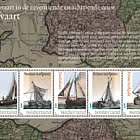
| Shipping in the 17th and 18th Centuries - Peat Shipping |
| Issued: 05.12.2025 |
| ›Netherlands |