Upheaval in Europe
The year 1476 and the two battles at Grandson and Murten mark a turning point in European history. 2026 sees the 550th anniversary of those events.
Skirmishes between the Swiss Confederates and Duke of Burgundy Charles the Bold, which initially appeared to be regional, grew into a political earthquake. Burgundy, one of the most powerful forces in Europe until that point, began to disintegrate, while the Confederates consolidated their position as a military and political power.
Grandson: loss of gold
On 2 March 1476, Charles the Bold’s troops encountered the Swiss Confederates at Grandson. Although the battle was virtually bloodless in military terms, the troops lost their entire camp, their artillery and their legendary treasure trove. This loss weakened the Burgundian army both strategically and symbolically, and marked the beginning of the decline of Burgundy as a major power.
Murten: loss of hold
The decisive battle at Murten followed just a few months later, on 22 June 1476. Here, Charles the Bold suffered a crushing de- feat: his larger and superior army, the most modern in Europe at the time, was pushed back, surrounded and beaten by the Swiss troops. This battle is still considered one of the defining moments in Swiss history it strengthened cohesion between the Swiss Confederates and helped establish their sense of identity as an independent political community.
A European turning point
Grandson and Murten tipped the balance of power. Burgundy, which had been a political powerhouse between France and the Holy Roman Empire for decades, lost its military influence, prestige and stability. The Swiss Confederation, meanwhile, finally established itself as a military power, suddenly renowned for its disciplined infantry, resilient formations and unexpected success against the Burgundians. The battle at Nancy in 1477 was the final chapter: Charles the Bold fell, Burgundy col- lapsed, and Europe was reshaped.
The Murten panorama
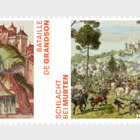
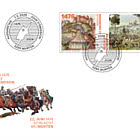
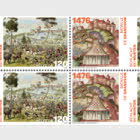
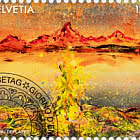
The Murten panorama, a small section of which can be seen on the stamp, is a 10 × 100 metre oil painting of na- tional importance. It depicts the moment when the Swiss Confederates gained the upper hand over the Duchy of Burgundy in the Battle of Murten in 1476. The German historical and military painter Louis Braun created the work on commission in 1893, working alongside more than 40 assistants. In the 19th century, panoramas were the most important visual mass media. Today, the work is rolled up and safely stored in a bunker owned by the Swiss Armed Forces.