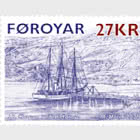
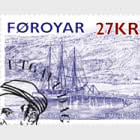
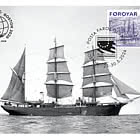
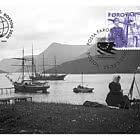
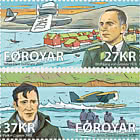
Dr Jean-Baptiste Étienne Auguste Charcot (15 July 1867–16 September 1936), known worldwide as “The Gentleman of the Poles”, was a French scientist and polar explorer. He became famous for his expeditions in both the southern and northern waters aboard the ship Pourquoi Pas? (“Why not?”). There were two vessels of the same name: the first a schooner, the second a three-masted barque with a steam engine. The results of his voyages were published in journals and books across the world.
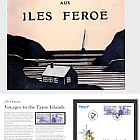
Elderly Faroese remembered Charcot with warm nostalgia, describing him as a kind and sharp-minded man a true friend of the Faroes. Charcot himself confirms this in Voyages aux Îles Féroé (1934), later published in Faroese as Ferðir til Føroya. Like the German researcher Carl J. Graba, he depicted the islands and their people in consistently positive terms, without reservation.
His accounts are remarkable for their combination of first-hand impressions from 1901 with careful analysis of developments up to 1934. By then, he had visited the Faroe Islands 10-12 times exceptional for his era.
Charcot first visited the Faroe Islands in 1901, again in 1902 and in 1912, and subsequently returned several times until 1936, with only the First World War interrupting his visits. Despite warnings from France about the harsh conditions, he replied unfalteringly: “Pourquoi Pas?” the same response he had previously given to his father, the renowned neurologist Jean-Martin Charcot.
On arriving in Tórshavn in 1901, he described a society dominated by fishing, sheep farming, and hunting. Infrastructure was almost non-existent: no quay, no telegraph, limited postal services, and no roads or cars. Only one ship, Smiril, connected the islands. Nevertheless, he highlighted the population as educated, friendly, and industrious.
By 1934, Charcot observed considerable progress: population growth, modernisation, electricity, banks, and improved healthcare. Tórshavn had expanded significantly, and new building materials and commercial goods had transformed the townscape. Despite these changes, he considered the character of the people essentially unchanged.
The Final Voyage and Shipwreck in 1936
Charcot and Pourquoi Pas? visited the Faroe Islands for the last time in the summer of 1936. The ship lay alongside the quay in Tórshavn, where the crew received visitors. On 26 and 27 July, supplies were loaded, including 18 tonnes of water. From there, the voyage continued north via Fuglafjørður and onwards to Greenland.
Newspapers reported that this was Charcot’s final expedition, and he was quoted as saying: “My ship is old and tired and so am I. But we grow old well together, both of us.” It was to prove a fateful irony.
After stopping in Greenland, the expedition proceeded to Iceland. In Reykjavík, the ship was repaired following a boiler failure and remained there for around two weeks, having been towed in by the Danish inspection ship HDMS Hvidbjørnen. On 15 September 1936, Pourquoi Pas? departed with 40 men on board fewer than planned, as some had returned home during the stopover.
The following hours proved disastrous for Charcot and his crew. Shortly after leaving Reykjavík, a violent storm broke out; so severe that several vessels were lost. The greatest tragedy, however, was the loss of Pourquoi Pas? near Álftanes. The ship struck a rock while attempting to return to Reykjavík in the severe weather, and the crew had likely confused two lighthouses. Of the 40 on board, only Gonidec, the third officer, survived. His account records the last hours, including the poignant sight of Charcot releasing a tame Greenland gull from its cage on deck; the bird, which had previously stayed close to the ship, flew away into the storm.
The disaster was extensive; 23 bodies were recovered in the first days. In Reykjavík, a memorial service was held with a large congregation, where Gonidec accompanied his deceased shipmates in coffins aboard a French warship, which transported them to Saint-Malo in France, where most were from.
In France, there was profound grief, and an official memorial was held at Notre-Dame Cathedral. The planned celebratory reception for Charcot was instead replaced by national mourning.
The Faroe Islands also mourned deeply the loss of their “Faroese friend” and his crew, and flags were flown at half-mast. At the same time, at least three Faroese vessels had been out in the same storm but reached harbour safely. Many were aware that the outcome could have been different, given the numerous Faroese ships lost over the years along Iceland’s coasts now sharing a fate with Charcot and his crew.
Álvur Danielsen