The amendment to Article 49 of the Spanish Constitution represents an unprecedented democratic milestone, as it is the first constitutional reform driven by organized civil society, led by the disability rights movement centered around CERMI (Spanish Committee of Representatives of People with Disabilities). This progress not only updates the legal framework but also incorporates a fairer perspective, in accordance with human rights, and with specific attention to those who have historically suffered the greatest inequalities: women and children with disabilities.
For decades, the original wording of Article 49 reflected a paternalistic approach that rendered invisible the multiple forms of discrimination faced by people with disabilities, and especially women and children, who encounter additional barriers in areas such as education, employment, social participation, health, and protection from violence—situations that cannot be addressed from a neutral or generic view of disability. The reform opens the door to a constitutional approach that recognizes this reality and demands more inclusive and gender-sensitive public responses.
The value of this reform also lies in its origin. The fact that this reform was promoted by civil society demonstrates the capacity of social movements to identify structural injustices, develop robust proposals, and build broad consensus. The CERMI civil society movement, together with disability organizations, has succeeded in placing the need for real and effective equality at the heart of the constitutional debate, giving visibility to those who have traditionally been relegated to the margins of legal and political discourse.
This constitutional change also has a far-reaching symbolic dimension. Explicitly recognizing the rights of people with disabilities, and doing so from a perspective that does not ignore the specific situation of women and children with disabilities, sends a clear message of democratic commitment. The Constitution is thus reaffirmed as a living text, capable of evolving and incorporating the demands of a diverse citizenry.
In short, the reform of Article 49 not only strengthens the social and democratic rule of law, but also places women and children and adolescents with disabilities in their rightful place, at the very heart of the constitutional pact.
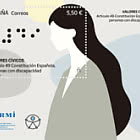
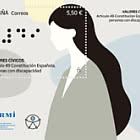
The image shows the UN Universal Accessibility logo, the CERMI logo, and the text that appears in braille is 49.