You know those hot summer afternoons when the sound of the cicadas seems to fill the hot, still air?
There are thirteen species of cicadas in Portugal, also known as the harbingers of summer. Although widely known to the public for their song, very few people have probably ever seen a cicada up close. They are cryptic and vigilant animals, which, when they sense the inquisitive gaze of a human, quickly go silent or fly away.
Only the male cicada sings in order to attract females for mating. This calling song is unique among all existing cicada species.
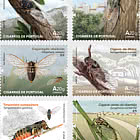
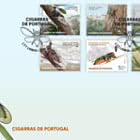
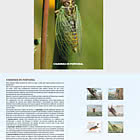
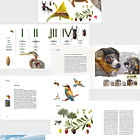
In collaboration with six Portuguese scientific illustrators, we selected the six species of cicadas that best represent the diversity of shapes, songs, habitats, but also threats, of our cicadas. We therefore aim to raise awareness of these small insects that fill our summer days, but elude our gaze.
Starting with Europe's largest cicada, the cegarregão (Lyristes plebejus), illustrated by Davina Falcão, mostly found in the districts of Santarém, Coimbra and Portalegre, with very small and fragmented populations. Its calling song resembles a pressure cooker. It can be heard between June and August and prefers tall trees for singing. It is a vulnerable species, especially to the large forest fires that are common in the centre of the country.
The cigarra-comum (Cicada orni), illustrated by Luísa J. Crisóstomo, is the most recognisable and common species in Portugal. It is also one of the few species that can withstand urbanisation, in wooded areas of cities from north to south of the country. Its ‘che-che-che’ call can be heard from June to October. The cegarregão-abelhudo (Hilaphura varipes), illustrated by Rita Cortez, is a species with a song akin to a metal duck. It is a rare, little-studied, endangered cicada, and the few known populations are small and scattered. It is found in the south-central part of the country, in meadows with scarce shrub vegetation, and calling song between May and June.
The cigarra-de-Maria (Tettigettalna mariae), illustrated by Carolina M. Correia, is a species almost restricted to the central coast of the Algarve. It is threatened by intense urban development, especially in Quinta do Lago, Vale do Lobo, Quarteira and Vilamoura. It prefers coastal pine forests of stone pine, where it sings between June and August. Its calling song resembles the sound of a sprinkler. The timpanista-compositora (Tympanistalna gastrica), illustrated by Cristina Espírito Santo, is a cicada with a very distinctive, rhythmic song similar to techno music. It is a small cicada that sings from May to July in habitats dominated by shrubs, or garrigues. It forms abundant populations in the central-western part of the country. Finally, the cigarra-verde-do-Alentejo (Euryphara contentei), illustrated by Joana C. Carvalho, is one of the smallest cicadas in Europe. It is found only on the Iberian Peninsula, mostly in the Alentejo region, and is one of the most endangered cicadas in Europe. It lives in native meadows and roadside margins, and is threatened by farming and pesticides. Its song, heard from May to July, is continuous and subtle, hard to hear.
We invite you to explore the sounds and biology of these and other cicadas in Portugal on the social media pages of the Cigarras de Portugal group at the Faculty of Sciences of the University of Lisbon. And just as they say that spring begins with the arrival of the first swallow, here summer only begins when you hear the first cicada.
Gonçalo J. Costa