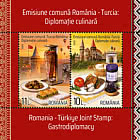
Romfilatelia and the Romanian Post introduce into circulation on Tuesday, June 30th, 2026,Romania-Türkiye joint stamp issue, under the theme of GASTRODIPLOMACY. The issue, consisting of two postage stamps, a philatelic block of two perforated stamps, and a First Day Cover, features products representative of both countries, as well as those from beyond their borders.
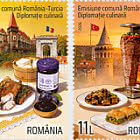
The postage stamp with the face value of Lei 10, dedicated to the theme of Romania, the image reproduces, as a composite whole, three representative products with European recognition: Topoloveni Plum Jam, Ibănești Telemea and Smoked Bighead Carp from the Land of Bârsa. On the stamp background are illustrated Corvin Castle located in the southwestern part of Transylvania, in the centre of Hunedoara County, in the southwestern part of the city, on the last eastern branches of the Poiana Ruscă mountains, and a miniature image of the Arch of Triumph in Bucharest, bearing the Romania’s flag.
Topoloveni Plum Jam has been part of Romanian tradition for more than a century, having first been produced for consumption in 1914, when the factory dedicated to its manufacture was established. Made solely from plums, with no added sugar and no preservatives, it preserves the taste of childhood and stands confirmed as a functional food, recognised as the first Romanian product to be certified PGI (Protected Geographical Indication) at European level.
Ibănești Telemea, a traditional Romanian cheese and the only Romanian product to have been certified at the European Union level as a Protected Designation of Origin (PDO), is produced exclusively from cow’s milk collected in the Gurghiu Valley (Mureș County). Its distinctive flavour and exceptional qualities are derived from the region’s rich, unpolluted pastures, and from the natural mineral water, rich in calcium and magnesium, which is used as brine during the cheese’s maturation process.
Bighead Carp is a fish raised in the waters of the Olt River floodplain, in the Land of Bârsa. Caught during the cold season, it is selected one by one from the dragnet and prepared for smoking after being manually scaled. The smoke comes from burning beech sawdust. Its distinctive flavour has earned it recognition as a product protected by a Protected Geographical Indication (PGI).
The postage stamp with the face value of Lei 11, dedicated to the Republic of Türkiye, depicts the world-renowned Döner kebab, alongside a serving of eggplant moussaka and the traditional dessert known as baklava, set against an iconic view of Istanbul featuring the Galata Tower.
It is known that Döner Kebab, which plays an important role in promoting Turkish culinary culture, was created approximately 150 years ago by İskender Bey, who lived in Bursa, inspired by the cooking technique used for roasted lamb. Döner kebab is defined as a product obtained by thinly slicing red or white meat, marinating it with various flavoring ingredients in specific proportions, tightly stacking it around a tubular metal skewer, cooking it on a vertically positioned rotating grill, and then cutting the cooked portions into slices approximately 3-5 mm thick with a long, sharp knife.
Eggplant Moussaka (Patlıcan Musakka) is a deeply rooted culinary heritage blended with centuries-old traditions of the Ottoman palace cuisine. In the province of Afyonkarahisar, this dish forms part of the city’s long-established “Sıra Yemekleri” (Communal Dining) tradition and the culinary discipline of the Mevlevi order.
Baklava is an ancient Turkish dessert, and the origin of the word is identified as “baklağu” or “baklağı”. The earliest Ottoman record concerning baklava dates back to 1473, during the reign of Sultan Mehmed II (Fatih Sultan Mehmet), when palace kitchen registers at Topkapı Palace documented the preparation of baklava.
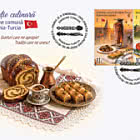
The First Day Cover of the Romania–Turkey joint issue “Gastrodiplomacy” presents, through an elegant graphic composition, representative elements of the gastronomic heritage of the two countries. It highlights culinary traditions that reflect cultural affinities, shared customs, and enduring bonds of friendship fostered through dialogue, cooperation, and mutual respect.
A traditional Romanian embroidered towel, adorned with authentic folk motifs, serves as the setting for a refined arrangement featuring Romanian cozonac and Turkish baklava, accompanied by coffee prepared in a traditional cezve (ibrik). Ready to be served in ornamental cups, these delicacies evoke the warm atmosphere of family gatherings and festive occasions. Their distinctive flavors celebrate the richness of culinary traditions and inspire appreciation for the time-honored recipes that have been preserved and passed down through generations in both countries.
Romfilatelia thanks its counterparts at the Turkish Postal Administration (Posta ve Telgraf Teşkilatı Anonim Şirketi), representatives of the manufacturing companies S.C. Sonimpex Topoloveni SRL, Mirdatod – Ibănești Dairy, SC Doripesco SA and the representatives of Hunedoara City Hall and Corvin Castle Museum, for the documentary support provided in the development of this joint stamp issue.