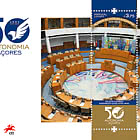
The Constitutional Autonomy of the Azores is one of the greatest political achievements of the Azorean people in the 20th century. It emerged from the Azorean’s desire to be able to decide their own destiny, whilst cherishing their identity, culture and geographical distinctiveness, which we call Azorean identity (exclusive feature of the Azorean people).
Although the idea of Autonomy has deep historical roots, it was after 25 April 1974, with the return of freedom and democracy to Portugal, that the Azoreans began to voice their desire for self-government more vigorously. In 1975, the Regional Council of the Azores was established, a temporary body responsible for preparing the Provisional Statute and administering the Region’s affairs until autonomy was established.
The Constitution of the Portuguese Republic, adopted on 2 April 1976, legally established the Regional Autonomy and the Autonomous Regions of the Azores and Madeira. For the first time in the country’s history, the existence of autonomous governing bodies for the island regions was recognised, endowed with political, legislative and executive powers, within the framework of the unity of the State. With the approval of the Provisional Statute for the Autonomous Region of the Azores on 30 April 1976, it was possible to establish the conditions for the effective commencement of the autonomous regime. The first elections to the Regional Assembly of the Azores, by free, direct and universal suffrage, took place on 27 June 1976, and the inaugural session of the Regional Assembly was held on 20 and 21 July in the city of Horta.
The new era of regional autonomy reached a particularly symbolic milestone on 4 September 1976, with the official opening of the Regional Assembly of the Azores in the city of Horta. The ceremony was attended by the highest-ranking State officials, lending special historical and political significance to this milestone in the consolidation of democracy and constitutional autonomy. A few days later, on 8 September, the first Regional Government, led by João Bosco Mota Amaral, took office, a unique moment in our history.
In 1980, the Political and Administrative Statute of the Autonomous Region of the Azores was approved, setting out the legal, political, executive and fiscal powers of the Autonomous Region. This marked the beginning of a new cycle of development and political responsibility. Since then, the Statute has been revised and updated, always with the aim of developing the Region's skills, strengthening cooperation with the Republic, and enhancing the Region's capacity to engage with other regions and the European Union.
Over the last fifty years, Autonomy has profoundly transformed the Azores. It has brought about significant progress in communications, education, healthcare and the promotion of the region’s natural and cultural heritage. The Azores asserted themselves within the country, within the European Union, in their relations with other regions and with our diaspora.
Much more than a political model, Constitutional Autonomy has become a living expression of Azorean people’s identity. It represents the right and responsibility to govern based on local engagement, an understanding of the island’s reality, and the collective aspiration to build a better future.
Organizing Committee for the 50th Anniversary
of the Constitutional Autonomy of the Azores