Mosaics have a Mediterranean tradition dating back almost three thousand years. Created as a more durable alternative to painting, they adorned the floors, walls and public buildings of ancient Greece and the Roman Empire. During the Byzantine period, they gained a new dimension with the use of glass and gold leaf. Islamic art developed complex geometric and vegetal motifs, while mosaics regained popularity in Renaissance Italy by connecting the ancient tradition with new artistic ideals. The characteristic colors of Mediterranean mosaics were inspired by the region’s natural landscape and are still frequently used in contemporary interior design.
They have been preserved better than almost any other form of ancient art thanks to a fortunate combination of circumstances. Made of stone, ceramic and glass, they were practically indestructible: they did not burn, rot or corrode. Incorporated into floors and walls, they were not easy to move or steal, while the ruins of buildings gradually covered and protected them like a natural layer. Christian churches actively preserved many mosaics as sacred objects. All this makes them one of the few forms of ancient visual culture that has come down to us in abundance and in excellent condition, as a valuable source for understanding aesthetics, iconography, everyday life and religious imagery, a kind of window into worlds that otherwise disappeared almost without a trace.
Mosaic artists developed different technical traditions: while the mosaics of the eastern Mediterranean retained rich polychromy and mythological scenes, black-and-white geometric motifs prevailed in Roman Italy and an almost playful freedom of ornament appeared in the North African provinces. Techniques became increasingly sophisticated, from the most widespread opus tessellatum, a technique based on the regular placement of square tesserae of uniform size, to the virtuoso opus vermiculatum, in which the tesserae follow the outlines of the figure in winding lines, creating an illusion of depth and volume.
The dimensions of individual works were impressive: the mosaics in Piazza Armerina, at the Villa Romana del Casale, cover more than 3,500 square meters. The mosaics of a single basilica in Salona, the 5th-century basilica at Marusinac, extended over approximately 660 square meters. The workshops of Salona operated from the second half of the 4th century to the end of the 6th century, developing a distinctive style of vibrant colorism and a refined ornamental vocabulary adapted to liturgical rites. However, the most famous examples of Late Antique mosaics on the Adriatic coast are those in the 6th-century Euphrasian Basilica in Poreč, created by a highly skilled group of mosaicists with exceptional attention to material and visual effect.
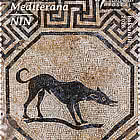
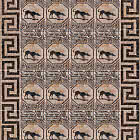
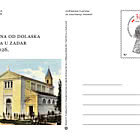
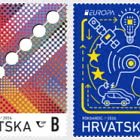
In Croatia, a particularly important place is also held by the mosaic from the Roman urban villa in Nin, ancient Aenona, dating from the turn of the 1st to the 2nd century. In an octagonal medallion with a meander border, it depicts the stylized dog, or wolf, shown on our stamp: a simple yet striking black silhouette of an animal in motion, testifying to the high technical standard of workmanship and the vitality of ancient Aenona.
dr. sc. Josip Belamarić,
Scholar – Emeritus of the Institute
of Art History