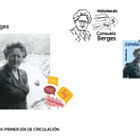
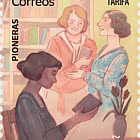
Born in Ucieda (Cantabria), Consuelo Berges (1899-1988) was raised by her paternal grandparents and taught herself to read and write, thanks to her grandmother's library. At the age of 15, after her grandparents died, she moved to Santander, where she graduated from the Normal School for Teachers.
She began working as a teacher in Cabezón de la Sal, at the school opened there by Matilde de la Torre, and in 1924, she began publishing in the newspaper La Región under the pseudonym Yasnaya Poliana, a reference to Leo Tolstoy's estate.
In 1926, she went to Peru, where she continued teaching and publishing literary articles, and in 1928 she moved to Buenos Aires, where she befriended Concha Méndez, among other intellectuals of the time.
In the autumn of 1931, after the proclamation of the Second Republic, Berges returned to Spain and settled in Madrid, where she established herself as one of the staunchest defenders of women's rights. She served as vice-president of the Fifth International Congress of Women, held in Madrid in 1932. She continued publishing articles and declined various positions, despite her precarious financial situation, because she "didn't want to be the director of anything." In 1939, shortly before the fall of Barcelona, she managed to leave the city and reach Portbou. Later, she went to Paris, where she lived in hiding until 1943, when she was arrested by the Germans and deported back to Spain.
She was spared imprisonment thanks to the intervention of, among others, Concha Espina, but she was forbidden from publishing any of her own work. It was at this point that translation became her only means of maintaining contact with literature. She translated Gustave Flaubert, Jean de La Bruyère, Marcel Proust, and others, becoming Spain's foremost and leading expert on Stendhal. Above all, she dedicated her life to fighting for better working conditions for book translators and advocating for their recognition as authors of their translations, becoming the first translator to receive royalties on the sales of her own work.
In 1956, she won the Fray Luis de León Translation Prize, awarded by the Spanish Ministry of National Education, for her translation of Jean Descola's *History of Christian Spain*.
In 1955, she and fellow translator Marcela de Juan founded APETI (Professional Association of Translators and Interpreters), the foundation and inspiration for the professional translation and interpreting associations that exist in Spain today.