The Gold of The Dacians - Reuniting the Historic Treasure
| Set |
| Miniature Sheet |
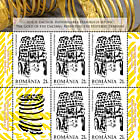
| Sheetlets |
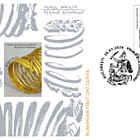
| First Day Cover |
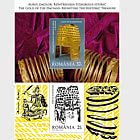
| Special Folder |
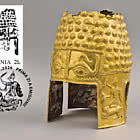
| Maxi Cards |
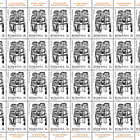
| Full sheets |
Romfilatelia and the Romanian Post introduce into circulation on Tuesday, July 28, 2026, the postage stamp issue entitled THE GOLD OF THE DACIANS: REUNITING THE HISTORIC TREASURE, consisting of a postage stamp, a perforated souvenir sheet, a maxicard, a First Day Cover and a philatelic folder with special product in a limited run printing.
The issue illustrates the Coțofenești helmet and two Dacian bracelets, artifacts of exceptional historical value that were stolen in January 2025 from the Drents Museum in Assen, the Netherlands, but recovered by the Dutch authorities and returned to the heritage of the National Museum of Romanian History.
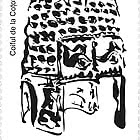
The drawings, depicted on the postage stamp (face value of Lei 21) and on the First Day Cover, are made by the renowned Romanian artist Mircea Cantor and illustrate images of the Dacian bracelets and a detail from the Coțofenești helmet. The author’s drawings are also found within the graphics of the special piece in the philatelic folder, where he combines the yellow color with the rope, an allusion to the gold of both the helmet and the bracelets – and where, in some places, one can identify, among the modules, the text: HISTORY IS ROPE.
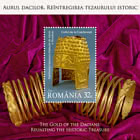
The souvenir sheet depicts in its stamp (face value of Lei 32), the real images of the two bracelets and the Coțofenești helmet, pieces from the heritage of the National Museum of History of Romania.
The Coțofenești Helmet is the best-known archaeological object discovered on the territory of Romania. Preserved in the collections of the National Museum of Romanian History, the gold helmet has a long history dating back to before 1927, when the artifact was purchased by Ion Marinescu Moreanu, a merchant from Ploiești, from Alexandru Simion, a resident of the village of Coțofenești, Prahova County. Two years later, this exceptional artefact entered the collections of the National Museum of Antiquities after Ion Marinescu Moreanu donated it to the Ministry of Public Instruction and Religious Affairs.
Archaeological investigations carried out in 1929 by the renowned archaeologist Ioan Andrieșescu led to the identification of the exact findspot, located on the summit of Măgura Hill, near a series of ravines. On that occasion, the circumstances surrounding the discovery were also reconstructed. According to local oral tradition, the helmet was found after heavy rainfall by three children, two of whom - Traian Simon and Vasile Simon - were the sons of Alexandru Simion. The object was broken into several pieces so that it could be divided among the children, and the upper part of the helmet’s crown was never recovered. The remainder of the artefact, in the form in which it can be admired today, came into the possession of Alexandru Simion and subsequently entered the patrimony of the Romanian State.
Dated to the fourth century BC, the helmet is the work of a highly skilled craftsman with an expert knowledge of Thracian art and the artistic traditions of the peoples of the North Pontic steppes. Fashioned from a single sheet of gold, the helmet originally had a conical crown with a rounded apex, decorated with conical rosettes arranged in horizontal registers. The brow band bears an iconographic motif: a pair of apotropaic eyes with eyebrows turned upwards in a spiral, believed to possess magical powers that protected against evil and afforded protection in battle. The same sacrificial scene is depicted on both cheek-pieces, showing a warrior or ruling figure sacrificing a ram. The neck guard is decorated with two superimposed friezes depicting fantastical creatures, including sphinxes and griffins.
The helmet was fashioned by cold hammering from a single sheet of gold using the repoussé technique. It is made of gold with a fineness of 760‰ and weighs 726.08 g. Its relatively modest dimensions - a height of 25.50 cm and a base diameter of 20 cm - suggest that it was most likely worn by a teenager or a short adult.
The function of this unique artefact was undoubtedly a symbolic one, its fragility being an obvious argument that it could not have served as a functional piece of military equipment. Furthermore, the site of the discovery and the absence of other prestige goods typical of Iron Age finds suggest that the deposition of the Coțofenești Helmet was ritual in nature, most probably representing a votive offering of religious or symbolic significance.
The Dacian gold bracelets are among the most spectacular archaeological discoveries of the twenty-first century, adding a fascinating chapter to the history of the Dacian Kingdom and of the political and religious centre at Sarmizegetusa Regia in the first century B.C.
Judicial investigations and scientific research carried out between 2005 and 2013 led to the identification of more than 24 multi-spiral gold bracelets originating from at least five distinct hoards, and the Romanian State succeeded in recovering 14 of them. The hoards had been deposited in areas situated close to important religious sites associated with the altars and temples surrounding the settlement at Sarmizegetusa Regia. Physico-chemical and microscopic analyses of the bracelets demonstrated that many of them had been deposited shortly after manufacture, as they show no signs of wear. Furthermore, the large diameter of some examples suggests that they were not intended to be worn. These findings have led to the conclusion that a significant number of the bracelets had a symbolic and ritual function, having been deposited as votive offerings immediately after their manufacture.
The bracelets were made from alluvial gold originating from the Transylvanian Gold Quadrilateral, the Dacian communities in the Orăștie Mountains practicing the extraction of alluvial gold by washing auriferous sands from the region’s watercourses and had access to substantial gold resources.
The 14 bracelets recovered have relatively similar weights, ranging from 822 to 1,228 grams. One exception is the bracelet known as the ‘Little Parisian’ - which weighs 682 grams and appears to have been adapted for the hand of a person with a more delicate build.
The perfectly shaped spirals are adorned with finials depicting the winged bodies of fantastical creatures, most likely dragons with bodies covered in fur or scales. These representations are often associated with the ‘draco’, the Dacians’ military standard, consisting of a wolf’s head and a dragon’s body, as depicted on the metopes of Trajan’s Column.
Romfilatelia thanks the renowned artist Mircea Cantor for his collaboration, Mrs. Dr. Cristina Tătaru and Mr. Cornel Constantin Ilie, Manager of the National Museum of History of Romania, for the documentary support provided in the development of this postage stamp issue.
Romania - Recommended stamp issues




WOPA+ recommended stamp issues


| Avatar - Fire and Ash |
| Issued: 03.12.2025 |
| ›New Zealand |
| 50th Anniversary of the Founding of the 24th November Bar Scout |
| Issued: 24.11.2025 |
| ›Montenegro |
| Krisjanis Valdemars |
| Issued: 02.12.2025 |
| ›Latvia |

| Sign Language - Good |
| Issued: 02.12.2025 |
| ›Bosnia and Herzegovina - Republic of Srpska |

| In Memory of the Fallen and Murdered on October 7, 2023 |
| Issued: 08.10.2025 |
| ›Israel |


| Annual Collection Folder (New York) |
| Issued: 05.12.2025 |
| ›United Nations |
| Year Set |
| Issued: 24.11.2025 |
| ›Isle of Man |
| Shipping in the 17th and 18th Centuries - Peat Shipping |
| Issued: 05.12.2025 |
| ›Netherlands |