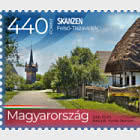
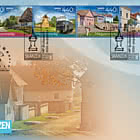
In 2026, Magyar Posta is issuing a strip of four special stamps on the topic of the Hungarian Open-Air Museum in Szentendre. Twenty thousand copies of the strip of four stamps were produced based on the design of the graphic artist Barnabás Baticz by the Pénzjegynyomda printing company. The strip of stamps is available from Filaposta, philately specialist services, certain post offices and www.posta.hu from 7 August 2026.
The Hungarian Open-Air Museum in Szentendre, generally known as the Skanzen, is Hungary’s largest outdoor museum and was founded in 1967. The aim of its foundation was to construct at a single location a collection of historic residential, agricultural, and industrial buildings representing the vernacular architecture of the different regions of Hungary, which could be visited as an open-air museum. As part of the Danube-Ipoly National Park, it is situated in a nature reserve on the south-eastern slope of the Visegrád Mountains, in the valley of the Sztaravoda Stream, hence not only the collection of build- ings but also the natural surroundings are specially protected. Set in grounds covering 75 hectares, the folk architecture, interior furnishings, farming practices, and way of life of the Hungarian-speaking areas come to life for visitors. The museum’s permanent exhibi- tions and regional sections, comprised of residential houses, farm outbuildings, mills, and churches, showcase the rural heritage of bygone eras. In each of the regional sections, the buildings are arranged according to the traditional layout of a peasant farmstead, which are complemented by sacred, communal, and economic buildings that were once part of the traditional village scene. The permanent open-air exhibition spans the period from the mid-18th century to the mid-20th century. The active and interactive areas of the museum’s exhibitions allow visitors to experience the atmosphere and aspects of tradi- tional rural life. In recent years, the Skanzen’s responsibilities have expanded signifi- cantly, and it now functions as a centre for museum education, teaching, training, intan- gible cultural heritage, and folk architecture. Source: skanzen.hu
The stamps in the strip show a streetscape from the Upper Tisza Region; the windmill from Dusnok and the Skanzen train; a streetscape from the Upland Market Town Region, and the main square of a Transylvanian town. The accompanying cover features a village streetscape with an autumnal atmosphere typical of Northern Hungary. The Skanzen’s logo appears as the postmark on the first day cover.