Canonization of Lady Maria Brancoveanu, Wife of Saint Constantin Brancoveanu
| Set |
| Sheetlets |
| First Day Cover |

| Full sheets |
Romfilatelia and the Romanian Post are adding a new postage stamp issue to the philatelic themes dedicated to the spirituality and history of the Romanian Orthodox Church, entitled CANONIZATION OF LADY MARIA BRÂNCOVEANU, WIFE OF SAINT CONSTANTIN BRÂNCOVEANU. The issue, comprising two postage stamps and a First Day Cover, will enter into circulation on Friday, August 14th, 2026.
Lady Maria Brâncoveanu (1661-1729), wife of the ruler of Wallachia, Constantin Brâncoveanu, represents a model of a Christian woman and mother – strong, well-balanced and deeply devoted to her family and the Romanian people. At its working session of July 1st, 2025, the Holy Synod of the Romanian Orthodox Church approved her canonization under the title of Saint Lady Maria Brâncoveanu with her feast day to be observed on August 16th.
The local proclamation of the canonization of Saint Maria Brâncoveanu will take place on Sunday, August 16th, 2026, at the Church of ‘St George the New’ in Bucharest, where the relics of the Holy Brâncoveanu Martyrs and of Saint Lady Maria Brâncoveanu are preserved.
Saint Lady Maria Brâncoveanu, also known as Marica, was an outstanding female figure, the mother of 11 children and the devoted wife of Saint Voivode Constantin Brâncoveanu.
Married at a very young age, she rose to the demands of her position as Lady of Wallachia. Despite the personal tragedy she endured following the martyrdom of her husband and her four sons, she remained dignified and steadfast in her faith and in her duty to her country.
Coming from an influential boyar family, with a father who held the office of postelnic (chamberlain) and a grandfather who was a ruler, Marica married Constantin Brâncoveanu in 1674, a young man who was well educated, wealthy and of noble descent. At the age of 13–14, she maturely embraced her role as a wife and homemaker, giving birth to 11 children, whom she raised with care and wisdom. She became a trusted partner to the ruler, managing the family’s wealth and overseeing its extensive network of estates and investments.
During the reign of Constantin Brâncoveanu, Wallachia experienced a period of peace and cultural flourishing. Lady Maria was actively involved in the management of the estates, the supervision of the foundations established by the ruling family, and the proper administration of the princely domains. She personally visited the estates, rewarded diligence and punished abuses, earning both the respect and the fear of all. In 1706, in an unprecedented act of courage, she addressed the Sultan directly in order to protect the family’s assets in Istanbul, and secured his approval.
Saint Lady Maria Brâncoveanu actively supported religious foundations, either by having new places of worship built or by restoring existing ones. Among the religious foundations for which she served as a patron were the Church of ‘Saint Nicholas of One Day’ and Surpatele Monastery. She also encouraged education and culture by supporting schools, printing presses and libraries. She supported the printing of books in several languages and the development of the arts, laying the foundations for the Brâncoveanu style. Together with the ruler, she ushered in an age of spiritual and cultural enlightenment.
The year 1714 was the most difficult year in Lady Maria’s life. Following Brâncoveanu’s deposition, the family was taken into exile, and Constantin and his four sons were martyred in Constantinople for refusing to renounce the Orthodox faith. Marica witnessed the terrible sacrifice, but she did not allow herself to be overcome by it. Having survived, she was imprisoned, robbed and exiled, yet remained steadfast in her faith, understanding her suffering as a cross ordained by God.
After three years in exile, Saint Lady Maria Brâncoveanu returned to Wallachia and began the struggle to recover the martyred remains of her husband. In 1720, she managed to secretly bring the relics of Saint Constantin Brâncoveanu to the Church of ‘St George the New’ in Bucharest, where she placed them beneath an uninscribed stone slab, keeping them anonymous for two centuries. A votive lamp, discreetly donated and bearing a simple inscription, was the only sign of the voivode’s presence in that place.
Until the end of her life, Saint Lady Maria Brâncoveanu continued to rebuild what remained of the Brâncoveanu legacy, caring for her grandson Constantin and securing his future. She brought an exceptional life to its close with dignity and faith, standing as one of the worthiest women in our history. Often retreating to Surpatele Monastery, she spent her final years in prayer, leaving behind a legacy of faith, culture and self-sacrifice that endures through the ages.
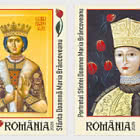
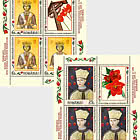
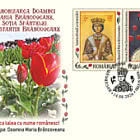
The postage stamp, with a face value of Lei 6 features the canonization icon, created by the painters Răzvan and Mihaela Bădescu, and forms part of the heritage of the Romanian Patriarchate.
The postage stamp, with a face value of Lei 21 features a portrait of Saint Lady Maria Brâncoveanu, a tempera painting on canvas using egg emulsion, measuring 50/60 cm, dated 2018, created by the iconographer Marieta Rotariu, a member of the Romanian Orthodox Women’s Association “Saint Lady Maria Brâncoveanu” of the Parish “Saint Gregory the Theologian and Saint Lady Maria Brâncoveanu” from Schiedam/Rotterdam, The Netherlands.
The First Day Cover features tulips bearing the name of Lady Maria Brâncoveanu.
Tulip: Lady Maria Brâncoveanu is the only tulip cultivar bearing a Romanian name. Since October 10th, 2018, it has been registered in the specialised nomenclature of the Royal Bulb Growers Association.
It is classified in the Triumph Group, with the following colour description: red 46B with a yellow edge 12A and a height of 50 cm. It is the result of a cross between the Groenland and Princess Victoria cultivars.
‘The red tulip with a yellow border, 02KTK8431’, a symbol of the blood of the Brâncoveanu Martyrs, the bleeding heart of the Saint Lady and the crown she wore with such dignity, was given the name Tulipa: ‘Lady Maria Brâncoveanu’.
The tulip was christened at the Romanian Orthodox Church of the ‘Lady Maria Brâncoveanu’ Association of Romanian Orthodox Women, in honour of Lady Maria Brâncoveanu (1661–1729) on March 25th, 2018, by Archpriest Ioan Dură, PhD.
Romfilatelia expresses its gratitude to His Beatitude Patriarch Daniel for the High Resolution and Blessing, to Mr Răzvan Mihai Clipici, Patriarchal Counsellor and Director of the Culture, Painting and Restoration Department of the Patriarchal Administration; to the Reverend Father Emil Cărămizaru, Parish Priest of the Church of ‘St George the New’ in Bucharest and to Ms Elena de Chiara, Vice-President of the Romanian Orthodox Women’s Association “Saint Lady Maria Brâncoveanu” of the Parish “Saint Gregory the Theologian and Saint Lady Maria Brâncoveanu” from Schiedam/Rotterdam, The Netherlands, for the documentary support provided in the development of this postage stamp issue.
Romania - Recommended stamp issues




WOPA+ recommended stamp issues

| Avatar - Fire and Ash |
| Issued: 03.12.2025 |
| ›New Zealand |
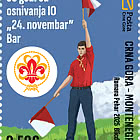
| 50th Anniversary of the Founding of the 24th November Bar Scout |
| Issued: 24.11.2025 |
| ›Montenegro |
| Krisjanis Valdemars |
| Issued: 02.12.2025 |
| ›Latvia |

| Sign Language - Good |
| Issued: 02.12.2025 |
| ›Bosnia and Herzegovina - Republic of Srpska |

| In Memory of the Fallen and Murdered on October 7, 2023 |
| Issued: 08.10.2025 |
| ›Israel |

| Annual Collection Folder (New York) |
| Issued: 05.12.2025 |
| ›United Nations |
| Year Set |
| Issued: 24.11.2025 |
| ›Isle of Man |
| Shipping in the 17th and 18th Centuries - Peat Shipping |
| Issued: 05.12.2025 |
| ›Netherlands |