George Enescu International Competition - Famous Musicians, George Enescu, Sergiu Celibidache and Yehudi Menuhin
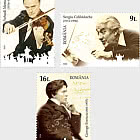
| Set |
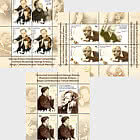
| Sheetlets |

| First Day Cover |
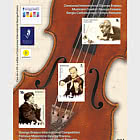
| Special Folder |
| Full sheets |
Enescu will be one of the great discoveries of the twenty-first century. It was Enescu who fired my imagination, opening up for me anew perspective on the tumult and grandeur of Bach. Enescu will remain for me the absolute by which I judge others.’
Sir Yehudi Menuhin
Sixty-eight years ago, on the initiative of the conductor George Georgescu, the first edition of theGeorge Enescu International Festival and Competition was organised in Bucharest. This Festival was intended not only as a mark of recognition of Enescu’s genius, but also as a tribute to his life and work.
Throughout its early editions, the Festival’s stage has hosted prestigious names from the world of music, including Lord Yehudi Menuhin, Sviatoslav Richter, Herbert von Karajan and David Oïstrakh.
On the occasion of the 20th edition of the George Enescu International Competition, Romfilatelia and the Romanian Post introduce into circulation on Friday, August 28th, 2026, the postage stamp issue George Enescu International Competition.
Famous Musicians: George Enescu, Sergiu Celibidache and Yehudi Menuhin. The issue, comprising three postage stamps, a First Day Cover and a philatelic folder with special product in a limited run printing, pays tribute to these three figures who have left an indelible mark of genius on classical music worldwide.
George Enescu, depicted on the postage stamp with the face value of Lei 16, was born on August 19th, 1881, in Liveni, Botoșani. He is regarded as the most important Romanian musician. His artistic talent manifested itself in many different roles: composer, violinist, teacher, pianist and conductor.
He began playing the violin at the age of four. Between 1888 and 1894 he was a student at the Vienna Conservatoire, after which he continued his studies at the Paris Conservatoire (1895–1899).
His compositional debut took place on February 6th, 1898, at the Concerts Colonne in Paris, with Poema Română, Op. 1. Enescu’s oeuvre comprises 33 works with opus numbers, spanning all musical genres and culminating in the opera Œdipe. Composed to a libretto by Edmond Fleg, it was performed at the Grand Opera in Paris on March 13th, 1936, a premiere that was a resounding success.
George Enescu’s musical activity was extremely intense, alternating between Bucharest and Paris. The musician gave numerous concerts both in Europe and on the American continent. As regards his teaching career, it can be said that he influenced a significant number of performers. As a teacher, George Enescu counted among his pupils the violinists Yehudi Menuhin, Christian Ferras, Ivry Gitlis and Arthur Grumiaux.
George Enescu, who passed away during the night of 3 to 4 May 1955, is buried in the Père Lachaise Cemetery in Paris.
Yehudi Menuhin, depicted on the postage stamp with the face value of Lei 7, was born on April 22nd, 1916, in New York, USA, into a Jewish family. He was one of the greatest musical figures of the 20thcentury and a much-loved pupil of George Enescu. He passed away on March 12th, 1999 in Berlin, at the age of 83, whilst still at the height of his creative powers, at a time when he still had many ambitious plans to fulfil and a well-defined schedule extending to 2003, including serving as Honorary President of the Enescu Festival in 2001.
The meeting between Enescu and Menuhin took place in 1927, when the young violinist, already regarded as a child prodigy, was only 11 years old. Impressed by his talent, Enescu agreed to become his teacher and mentor. The lessons held in Paris and at Villa Luminiș in Sinaia went beyond the scope of instrumental technique, becoming a true initiation into the depths of musical art. Enescu instilled in his pupil the conviction that music should be understood and experienced with sensitivity and authenticity.
Speaking of his pupil, the Maestro remarked: ‘He was already a true virtuoso at the age of 12; by 15, he was a mature artist. Later on, we had nothing left to discuss but the depths of his style. I believe… I can be proud of him.’ In the same vein, Enescu confessed: ‘I taught him that true art comes from within, not from without.’
For Yehudi Menuhin, George Enescu remained a pivotal figure in his artistic and personal development. The violinist repeatedly acknowledged the decisive influence of his mentor, stating: ‘Enescu was the greatest teacher I ever had and one of the most profound influences in my life.’ He also went on to say: ‘Enescu will be one of the great discoveries of the 21st century (…) Enescu will remain for me the Absolute by which I judge others.’
On June 28th, 1912, Sergiu Celibidache (the image depicted on the postage stamp with the face value of Lei 9) was born in the city of Roman; he was to transform the art of conducting into a true art of the spirit. A quiet and contemplative child, he discovered the world of sound at an early age, and at just four years old he began playing the piano. Music was to become, for the rest of his life, his language, his destiny and his way of understanding the world.
Against his father’s wishes, who had prepared him for a political career, the young Celibidache chose the path of music and left home. He studied mathematics, philosophy and music, first in Romania and then in Paris and Berlin. There, he encountered some of the great teachers of the era, attended Wilhelm Furtwängler’s rehearsals with fascination, and discovered Zen philosophy, which would profoundly shape his way of thinking about music.
In war-ravaged Berlin, amidst shortages and air raids, his talent began to shine through. In 1945, at just 33 years of age, he took the podium of the Berlin Philharmonic, embarking on a career that would lead him to the great stages of the world. His extraordinary memory, exacting standards and the intensity of his performances made him an unmistakable conductor.
For Celibidache, music could not be preserved in a recording. It had to be experienced. It was born in a unique moment, from the encounter between sound, space, the orchestra, the conductor and the audience, and then vanished with the final note.
The great Romanian conductor Sergiu Celibidache died on August 14th, 1996, aged 84, at his home in La Neuville-sur-Essonne, France, near Paris.
Sergiu Celibidache was not merely a great conductor, but a seeker of the meaning concealed within sound an artist for whom music began where words ended.
Romfilatelia thanks its institutional partners Artexim, the ‘George Enescu’ National Museum and the George Enescu Philharmonic for their documentary support, and Ms Adela Celibidache and the photographer Emanuel Tânjală for their collaboration on the development of this postage stamp issue.
Romania - Recommended stamp issues




WOPA+ recommended stamp issues


| Avatar - Fire and Ash |
| Issued: 03.12.2025 |
| ›New Zealand |
| 50th Anniversary of the Founding of the 24th November Bar Scout |
| Issued: 24.11.2025 |
| ›Montenegro |
| Krisjanis Valdemars |
| Issued: 02.12.2025 |
| ›Latvia |

| Sign Language - Good |
| Issued: 02.12.2025 |
| ›Bosnia and Herzegovina - Republic of Srpska |

| In Memory of the Fallen and Murdered on October 7, 2023 |
| Issued: 08.10.2025 |
| ›Israel |


| Annual Collection Folder (New York) |
| Issued: 05.12.2025 |
| ›United Nations |
| Year Set |
| Issued: 24.11.2025 |
| ›Isle of Man |
| Shipping in the 17th and 18th Centuries - Peat Shipping |
| Issued: 05.12.2025 |
| ›Netherlands |