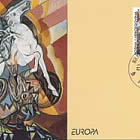
Europa's abduction
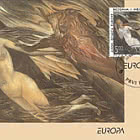
EUROPA, who was the daughter of the Phoenician king Agenor, used to play on the sea beach. The father of all gods, Zeus, having seen her, fell passionately in love with her. He turned into a white bull and when the curious girl mounted his back rushed into the sea and ran away with his pray. Accompanied by gods and nymphs he took Europa to the island of Crete. In a cave there he became united with his beloved who bore him three sons, Minos, Radamant and Sarpedon. In order to immortalize his love Zeus, the supreme god, caused the Cretan planetrees never to lose their leaves. At the parting Zeus presented Europa with a hunting spear that would always hit the target as well as with some precious jewellery. Europa was very often represented in the fine arts (Titian, Veronese, Lorrain, Moreau and others). The myth about the rape of Europa symbolizes the transplantation of Asian culture onto Crete, the otherwise cradle of European civilization.
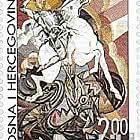
St. George Slaying the Dragon
ST.GEORGE (Sanctus Georgius), according to tradition a Roman officer, was subjected to torture in Cappadocia in 303 A.D. at the time of Dicletian’s prosecution of Christians. He is commemorated on April 23. The veneration of St. George was first connected with Palestine and Egypt, later spreading to Byzantium. In Europe his cult spread during the crusades. George thus developed into the ideal of a Christian knight. Since the 12th century performances featuring St. George fighting the dragon started taking place and he became the most popular saint of the Middle Ages. In the agricultural and cattle rising he became the patron saint protecting the soil, crops, greenery and cattle. With the Croats he substituted some older pre-Christian cattle rising and agricultural cults. In Dalmatia and Herzegovina there are many small churches to be found on hilltops dedicated to St. George. He is also represented on a number of standing tombstones, charging at the dragon with his spear (Metković, Poljica, Konjic, Vrgorac).