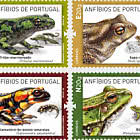
Between 1853 and 2026, more than 360 species that are part of Portugal's natural heritage have been featured on stamps. Amphibians, however, have not. They were the only group of vertebrates not to feature on stamps and the most threatened on the planet: around 41 per cent of species are globally at risk of extinction. This issue fills that gap, not as a celebration, but as a diagnosis. Portugal is home to around twenty native species. As vertebrates with dual citizenship both aquatic and terrestrial they act as environmental sentinels: their permeable skin detects, before we do, pollution, habitat loss and the climatic tipping points that are reshaping ecosystems. They devour insects by the hundreds, controlling agricultural pests and disease carrying mosquitoes a silent service that our food supply and our health rarely take into account. Yet their conservation receives less than 4 per cent of the global funding allocated to the rest of biodiversity.
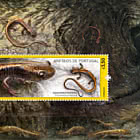
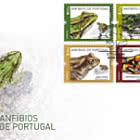
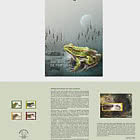
These five stamps the first of their kind offer a glimpse of the country's amphibian diversity. The appeal of an intriguing gaze was used as a gateway to empathy. The deliberate choice focused on diversity, rather than conservation status, and on three ways of inhabiting space: water and the underground world, the shore and the land.
The perez's frog (Pelophylax perezi; LC = Least Concern), with its golden eyes, is the only one of the five main characters in this programme that is also found in the Azores and Madeira islands having been introduced there by humans. The spiny common toad (Bufo spinosus; LC), the largest Portuguese toad, ranges in colour from brown and caramel orange to olive green. The fire salamander (Salamandra salamandra; LC) displays one of the clearest warning signals in European wildlife: black and yellow aposematism, the same visual language that makes us fear wasps and that we 'invented' to signal danger on the roads. The marbled newt (Triturus marmoratus; LC) displays a striking pattern of lettuce green and black, with the breeding male bearing a spectacular dorsal crest. The gold striped salamander, (Chioglossa lusitanica, VU = Vulnerable), on the other hand, is an Iberian endemic and the only threatened species among these five, projects a ballistic tongue to capture invertebrates and draws attention to its tail, whose spasmodic writhing distracts the predator whilst it escapes. Its decline mirrors that of the native forest and the springs.
A stamp is not limited to the image it contains: it can point beyond it. By capturing the representative image printed on the stamps, you will not only be able to recognise and identify the species more effectively but also record its presence. Each item on this page links to BioDiversity4All the Portuguese hub of the world's largest citizen science community (iNaturalist), whose records feed into the archive of GBIF the Global Biodiversity Information Facility* on a worldwide basis. Beyond collecting, we will become active participants. And because a paper stamp lasts for decades whilst an email address rarely does, the link is thus anchored to a persistent identifier: even if the terminology changes and science frequently revises names: a species placed in one genus today may be assigned to another tomorrow the stamp will continue to point to the current state of knowledge. The stamp thus reinvents, once again, the scope of its contribution to society and nature, in the pursuit of ecoliteracy.
Fernando J. S. Correia
Biologist and scientific illustrator