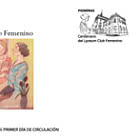
The library of the Lyceum Club Femenino in Madrid was a central space for this pioneering association in the history of feminism—an organization whose centenary will be celebrated in 2026. More than just a collection of books, the library served as the intellectual epicenter of a social, cultural, and political community that was unprecedented in the Spain of its time.
María de Maeztu, Victoria Kent, Zenobia Camprubí, Clara Campoamor, María Teresa León, Carmen Baroja... The complete list of members remains unknown because the Lyceum’s records were scattered or lost during the dictatorship; however, research driven by the Ministry of Culture has made it possible to recover the most extensive roster of members ever identified. This list includes over 500 women whose identities are being restored, thanks to a successful model of collaborative research involving public institutions, archives, and the general public.
The Lyceum became a meeting point for the various feminist efforts that had begun decades earlier. Its ten years of activity reflected the commitment of women from diverse fields—writers, scientists, artists, legal experts, and educators. Together, they fostered women's professional, cultural, and educational growth; hosted lectures by national and international figures, as well as recitals, courses, and book presentations; and organized monographic exhibitions of female artists. In their meeting rooms, they debated strategies regarding women's suffrage—finally approved in 1931—and spearheaded two vital social initiatives: the *Casa de los Niños* (Children's House) and the *Comité del Libro para el Ciego* (Book Committee for the Blind).
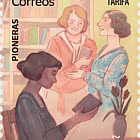
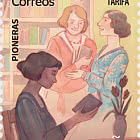
The club's first headquarters opened in 1926 in the historic *Siete Chimeneas* (Seven Chimneys) building, which currently houses the Ministry of Culture. In 1931, the club moved to nearby 44 San Marcos Street. Surviving records confirm that the members zealously guarded the books until the collection was seized by the Falange. Sadly, the library was auctioned off decades later during the democratic era, and today, only a few titles have been recovered. It is this space that is evoked by the commemorative stamp illustrated by Clara de Frutos. Its image calls to mind that shared space where ideas, conversation, culture, and unity contributed to the struggle for women's equality and freedom in our country's public and political spheres.