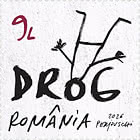
Joint Issue Romania-Kazakhstan - Biosphere Reserves
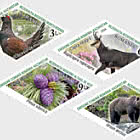
| Set |
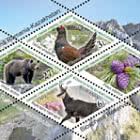
| Miniature Sheet |
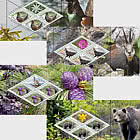
| Sheetlets |
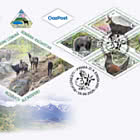
| First Day Cover |
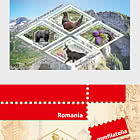
| Special Folder |
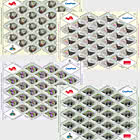
| Full sheets |
Romfilatelia and the Romanian Post are introducing into circulation on Friday, September 18, 2026, Romania – Kazakhstan joint stamp issue, under the theme BIOSPHERE RESERVES.
The issue, consisting of four postage stamps, a philatelic block of four perforated stamps, a First Day Cover and a philatelic folder with a special product in a limited run printing, presents representative species from the Rodnei Mountains Biosphere Reserve and the West Altai Biosphere Reserve.
Romania recognized the state independence of the Republic of Kazakhstan on December 17, 1991, one day after its proclamation. On July 15, 1992, Romania and the Republic of Kazakhstan established diplomatic relations.
Rodnei Mountains National Park is designated Rodnei Mountains Biosphere Reserve. It is the second-largest national park in Romania, a covering an area of 47,202 hectares and located in the northern group of the Eastern Carpathians. The importance of this protected area lies both in the geology and geomorphology of the mountains and in the presence of numerous species of fauna and flora, including endemic species and glacial relicts. From an administrative point of view, the park extends across Maramureș and Bistrița-Năsăud counties.
Efforts to protect nature, flora and wildlife date back to the interwar period and culminated in 1932, when 183 hectares of alpine grassland in the Pietrosu Mare area, Maramureș County, were declared a nature reserve, remembered as the first reserve of its kind in Romania. Owing to the particular importance and beauty of the surrounding forest belt, the reserve was expanded to 2,700 hectares in 1962 and subsequently to 3,300 hectares in 1977.
A landmark in the development of this protected area was the granting of its most important status: in 1979, in Paris, this 3,300-hectare area was designated a Biosphere Reserve by the United Nations Educational, Scientific and Cultural Organization under the Man and the Biosphere Programme (MAB-UNESCO).
This international recognition, together with the continuous efforts of Romanian specialists – foresters, biologists, botanists, entomologists, geographers, soil scientists and ornithologists – consolidated the core of what would later become Rodnei Mountains National Park. This status is also mentioned in Romanian legislation. Subsequently, pursuant to Law No. 5/2000 and Government Decision No. 230/2003, Rodnei Mountains National Park is recognized as a Biosphere Reserve, having been granted this status in 1980 by the UNESCO MAB Committee in Paris.
At the entrance to the national park from Borșa lies Horses’ Waterfall (Cascada Cailor), in an area of exceptional scenic beauty. The cliffs in the area are also a major attraction for climbers.
In addition to the strictly protected areas of Pietrosul Mare (3,084 hectares), Piatra Rea (201 hectares), Ineu-Lala (960 hectares) and Corongiș (401 hectares), there are several natural protected areas of national interest: the Daffodil Meadow on the Saca Massif, the Cave in the Cobășel Valley, Bătrâna Spring, Mihăiasa Springs, and the Izvorul Albastru al Izei Cave and Karst Spring.
Rodnei Mountains National Park fully overlaps with the Site of Community Importance ROSCI0125 Rodnei Mountains and the Special Protection Area for Birds ROSPA0085 Rodnei Mountains.
Points of interest are:
glacial cirques and lakes, peaks exceeding 2,000 metres (Ineu Peak and Pietrosul Peak), mountain pine (Pinus mugo) stands with Swiss pine (Pinus cembra), and spectacular mountain landscapes. Are present here: the Daffodil Meadow on the Saca Massif, situated at an altitude of 1,600 metres, offers a magnificent view.
Natural waterfalls and geological formations.
Mountain flora: bellflowers, the Rodnei Mountains catchfly a Carpathian endemic species, gentians, edelweiss and mountain peony.
Fauna characteristic of the area: brown bear, wolf, lynx, red deer, roe deer, wild boar, chamois, marmot, western capercaillie and black grouse.
The species encountered are:
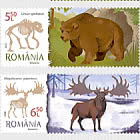
The chamois (Rupicapra rupicapra), illustrated on the stamp with the face value of Lei 6, plays an essential role in maintaining the ecological balance and health of mountain ecosystems in the Carpathians. As a herbivore, it feeds on alpine grasses, mosses and lichens, helping to regulate their growth and contributing to the natural regeneration of vegetation. It is also an important food source for large mountain predators such as wolves, lynxes and bears, thus facilitating the flow of energy through the ecosystem.
The western capercaillie (Tetrao urogallus), depicted on the stamp with the face value of Lei 3, plays an essential ecological role as an indicator species of the health of old-growth coniferous forests and contributes to maintaining the trophic balance of mountain ecosystems. By feeding on buds, shoots, conifer needles and wild berries such as blueberries, it influences the dynamics of local flora. It is also part of the food chain, serving as important prey for large birds of prey and carnivorous mammals such as the lynx and golden eagle.
West Altai Biosphere Reserve
The West Altai State Nature Reserve is located in East Kazakhstan and is part of the UNESCO biosphere reserve community. Its territory covers unique mountain ecosystems rich in flora and fauna, serving as an important center for biodiversity conservation.
The brown bear (Ursus arctos), depicted on the stamp with the face value of Lei 27, is one of the largest predators of Eurasia. This species plays a key role in Altai ecosystems, acting as an indicator of environmental health. The bear is known for its powerful build, keen sense of smell, and omnivorous diet.
The Siberian pine, species illustrated on the stamp with the face value of Lei 9, features cones of the Pinus sibirica. They contain nutritious nuts that are vital for forest ecosystems and humans alike. The cedar is a symbol of the Altai taiga, ensuring the stability of forest communities and providing valuable resources.
Romfilatelia thanks the representatives of the RNP - Romsilva Rodnei Mountains National Park Administration R.A., National Forest Administration - Romsilva, the Romanian National Commission for UNESCO, the Embassy of Romania in the Republic of Kazakhstan, and the Postal Administration of the Republic of Kazakhstan for their documentary support and cooperation in the production of this postage stamp issue.
Romania - Recommended stamp issues





WOPA+ recommended stamp issues

| Avatar - Fire and Ash |
| Issued: 03.12.2025 |
| ›New Zealand |

| 50th Anniversary of the Founding of the 24th November Bar Scout |
| Issued: 24.11.2025 |
| ›Montenegro |
| Krisjanis Valdemars |
| Issued: 02.12.2025 |
| ›Latvia |

| Sign Language - Good |
| Issued: 02.12.2025 |
| ›Bosnia and Herzegovina - Republic of Srpska |

| In Memory of the Fallen and Murdered on October 7, 2023 |
| Issued: 08.10.2025 |
| ›Israel |

| Annual Collection Folder (New York) |
| Issued: 05.12.2025 |
| ›United Nations |

| Year Set |
| Issued: 24.11.2025 |
| ›Isle of Man |
| Shipping in the 17th and 18th Centuries - Peat Shipping |
| Issued: 05.12.2025 |
| ›Netherlands |