Historic Romanian Train Stations

| Set |
| Sheetlets |
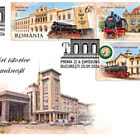
| First Day Cover |
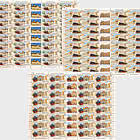
| Full sheets |
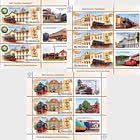
Romfilatelia and the Romanian Post introduce into circulation on Friday, September 25th, 2026, the postage stamp issue HISTORIC ROMANIAN TRAIN STATIONS.
The issue, consisting of three postage stamps and one First Day Cover, addresses a dual theme, namely architecture and means of railway transport. The postage stamps depict the train stations of Curtea de Argeș, Iași and Arad, shown alongside old train tickets and steam locomotives in an original concept.
The Royal Train Station in Curtea de Argeș, illustrated on the postage stamp with the face value of Lei 5.50, is an architectural gem and a historic monument, inaugurated on November 27th, 1898.
It was designed by the Italian architect Giulio Magni, incorporating elements typical of an Italian villa, and was intended for use by the royal family.
The works were overseen by the renowned engineer Elie Radu, to serve the Pitești-Curtea de Argeș railway line (38.4 km in length).
It was an oasis of elegance for the royal trains that carried the sovereigns to Curtea de Argeș Monastery.
After a long period of decline following 1989, the building recently began a rehabilitation process to restore it to its former splendour. It is an important tourist landmark on the map of Romania.
Iași Train Station, depicted on the postage stamp with the face value of Lei 6,50, was partially inaugurated on June 1st, 1870, and is one of the oldest and most spectacular train stations in Romania.
The train station’s main building was designed by the Austrian architect Johan De Wacter. Situated in the Bahlui area, it stands out for its unique features within the Romanian railway landscape.
Inspired by the Doge’s Palace, the building has a Venetian Gothic appearance and is notable for its carved loggia on the upper floor, which is why it is also known as the ‘Doge’s Palace’ of Moldavia. It was the third train station to open on Romanian territory as it was at the time, and the first train arrived amid great celebration.
The original building was an imposing 133.8 metres long and housed 113 rooms. Between 1928 and 1930, two side wings were added symmetrically to the train station.
The most spectacular architectural feature is the Venetian-style loggia on the upper floor, featuring five bays and carved stone columns and is topped by three ogives. The central ogive was designed to house a clock with a transparent dial.
Shortly before the works were completed, on April 21st, 1869, Prince Carol I himself inspected the works and was officially received by the Austrian engineers of the construction company, Lemberg-Czernowitz-Jassy Eisenbahn.
At the time of its inauguration, the building was painted a shade of candy pink, whilst the loggia was a bright red. Standing in stark contrast to the green plains of the Bahlui, the writer Ion Mitican described it as ‘a fortress of fire rising in the midst of a verdant delta’.
Arad Train Station, illustrated on the postage stamp with the face value of Lei 21, in its original form, was opened on October 25th, 1858, when the first railway line, Lőkösháza - Curtici - Arad, was inaugurated.
The first building (1858) served as a key point on the railway map of the time, but over the years it became too small.
The current building (1905-1911 / 1909-1912) was built in the renowned Secession style (a variant of Art Nouveau), based on plans by the Hungarian architect Ferenc Pfaff.
In October 1944, the building sustained damage as a result of heavy bombing during the World War II, and was subsequently restored.
In the 2010s, the train station underwent extensive refurbishment and modernisation to bring it into line with European railway traffic standards.
The First Day Cover of the issue depicts the building of the North Train Station in Bucharest.
The North Train Station in Bucharest is found in the project contracted with the H. B. Strousberg Company, starting in 1868, when Carol I laid the foundation stone of the construction. The land on which the station was built under the name of Târgoviștei Train Station belonged to Zoe Racoviță, granddaughter of the nobleman Dinicu Golescu and wife of Effingham Grant (brother of Maria Rosetti, the “Revolutionary Romania” of the painter Rosenthal).
In 1872, the railway station was inaugurated, and with it the Roman-Galați-București-Pitești railway line. It was initially used for mixed transport (passengers and cargo), and then only for passengers. After the War of Independence in 1877, to commemorate the heroes who fell in the battles of Grivița, Calea Târgoviștei was named Calea Griviței.
Târgoviștei Train Station entered the international railway circuit on June 8th, 1883, when it received the “Orient-Express” trainset. After several interventions aimed at modernization, in 1888, the name of the North Train Station was unanimously adopted.
In 1889, the first telephone installation of the CFR (Romanian Railway Company) came into operation, and later the telephone switchboard with 25 lines was inaugurated. A new wing of the building, which would later house the Royal Salon, was completed in 1894.
Romania - Recommended stamp issues





WOPA+ recommended stamp issues

| Avatar - Fire and Ash |
| Issued: 03.12.2025 |
| ›New Zealand |

| 50th Anniversary of the Founding of the 24th November Bar Scout |
| Issued: 24.11.2025 |
| ›Montenegro |
| Krisjanis Valdemars |
| Issued: 02.12.2025 |
| ›Latvia |


| Sign Language - Good |
| Issued: 02.12.2025 |
| ›Bosnia and Herzegovina - Republic of Srpska |

| In Memory of the Fallen and Murdered on October 7, 2023 |
| Issued: 08.10.2025 |
| ›Israel |


| Annual Collection Folder (New York) |
| Issued: 05.12.2025 |
| ›United Nations |

| Year Set |
| Issued: 24.11.2025 |
| ›Isle of Man |
| Shipping in the 17th and 18th Centuries - Peat Shipping |
| Issued: 05.12.2025 |
| ›Netherlands |