Ahead of her time
Not understood in her lifetime, but later celebrated worldwide: Heidi Bucher would have turned 100 this year one more reason to pay tribute to the work of one of Switzerland’s most important artists.
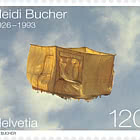
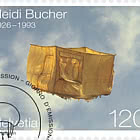
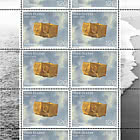
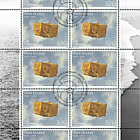
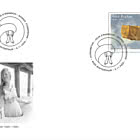
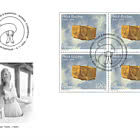
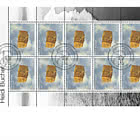
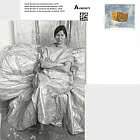
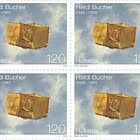
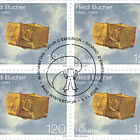
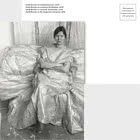
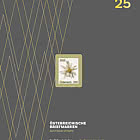
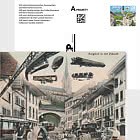
A room drifts through the air, the walls fluttering in the wind the design shows one of Heidi Bucher’s best known works, Fliegender Hautraum [Flying Skinroom]. She created the work in 1981 in her grandparents’ ancestral home; it is a typical example of one of her famous “skins”, produced using an archaeological conservation technique by covering rooms with liquid latex and textiles before allowing the layers to dry and peeling them off like a skin. It is a way of creating impressions of places of remembrance between preservation and transformation.
“My mother was truly Avant Garde, a kind of emancipation artist constrained by the Helvetian corsets of the time. The skinroom represents freeing yourself from the past, from conventions, constraints and patriarchal structures. A bold statement that was sadly not understood by Swiss society or the art scene at that time,” explains her son, Mayo Bucher, who designed the stamp and is custodian of his mother’s artistic legacy.
Uncompromising visionary
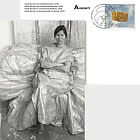
Heidi Bucher (then Heidi Müller) was born in 1926 in Winterthur in to a middle-class family. She studied under Johannes Itten, Max Bill and Elsie Giauque at the arts college in Zurich. In 1955, she moved to New York, where she was the only woman in a group exhibition of the 44 most influential artists of the time. Theexhibition in the legendary World House Gallery still reads like a Who’s Who of the art world: from Hans Arp, Giorgio Morandi and Heidi Müller to Edward Munch, Wassily Kandinsky and Kurt Schwitters. Decades later, her son reflects on the event: “I have to say ‘Wow, Mum really impressive that you achieved all that so early’.”
From 1960, Heidi Bucher returned to Switzerland, before returning to live in North America again for several years with her husband and two sons a few years later. Heidi Bucher had to hold her ground in an art world dominated by men. Despite initial success, her big break remained elusive. “It was frustrating but also brought freedom. Outside of the limelight, our mother could forge her own uncompromising path to become the pioneering object and conceptual artist that we know her to be today,” says Mayo Bucher.
Recognition for her life’s work
Heidi Bucher died in 1993 in Brunnen in the canton of Schwyz. Broader recognition came only after her death. In 1994, she post- humously received the cultural award for the city of Winterthur. International acclaim followed, especially from the 2010s after worldwide exhibitions in Asia, USA, Switzerland and at the Biennale in Venice. “Perhaps she was just ahead of her time. Or perhaps she was always working for posterity. As is the case for all truly significant artists, she created something that has lasted beyond her own lifetime. This is why I’m particularly delighted that her life’s work is now being recognized in the form of a stamp. I like to think that, as a stamp, the skinroom is continuing its flight around the world.”