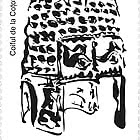
The Palaces of the Romanian Post
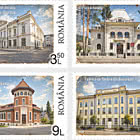
| Set |
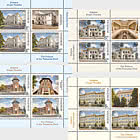
| Sheetlets |
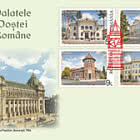
| First Day Cover |
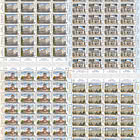
| Full sheets |
Ahead of World Post Day, Romfilatelia and the Romanian Post introduce into circulation on Thursday, October 8th, 2026, a new postage stamp issue on the theme of Architecture, entitled THE PALACES OF THE ROMANIAN POST.
The issue, made up of four postage stamps and a First Day Cover, depicts the following buildings, all historic monuments: the Stamp Factory, the Post Palace in Iași, the Post Palace in Râmnicu Vâlcea, the Post Palace in Piatra-Neamț and the former Palace of the Posts in Bucharest.
The postage stamp with the face value of Lei 16 depicts the current premises of the Stamp Factory (built in 1924).
The history of the Stamp Factory began on February 29th, 1872, when the Stamp and Registration Law was adopted, regulating the use of revenue stamps in Romania. The Ministry of Finance, which wished to have the stamps required by the General Directorate of Posts printed domestically, held discussions with the French authorities, who were printing Romanian postage stamps bearing the effigy of King Carol I, as well as the first domestically produced revenue stamps. Shortly afterwards, in the same year, the Service for the Manufacture, Preservation and Distribution of Stamps - the Stamp Factory - was set up within the Ministry of Finance. At that time, the factory was equipped with four hand-operated printing presses brought from Vienna. It was not until four years after the Stamp Factory was founded that the workshop began printing postage stamps as well, using electrotype plates brought from Paris, which had been used by the French to engrave the stamps bearing the image of King Carol I.
The Post Palace in Iași is depicted on the postage stamp with the face value of Lei 3.50.
The building, also known as the Balș-Sturdza House, has a rich history, being built between 1835-1850.
Over time, the building served as a boyar residence and as the headquarters of the Bank of Moldavia, the City Hall and the Iași branch of the National Bank, before becoming the seat of the Post Office after the World War II. In the past, it hosted balls, literary circles and cultural gatherings, and it was an important landmark on the map of the old city.
The earliest records of this property date back to 1842, when it was owned by Iordache Bals.
The building, constructed between 1835 and 1850, was originally called the Balș-Sturdza House.
On the plaque of the Post Palace in Iași is inscribed the text: “In this house - a historical monument from the 19th century, Titu MAIORESCU, the illustrious writer, professor and dignitary, inaugurated, in February 1863, the famous LECTURES of JUNIMEA from Iași.”
The Post Palace in Râmnicu Vâlcea, depicted on the postage stamp with a face value of Lei 9, was built between 1907 and 1909 to a design by the architect Nicolae Ghica-Budești, and the building is a historic monument.
The Post Office building, made of exposed brick and adorned with elegant stone window surrounds, was an important landmark and a meeting place for young people. The Post Office yards included storehouses and stables for the stagecoach horses. From in front of the Post Office, the post coach and the stagecoach would set off, drawn by six horses and driven by a coachman, with an armed guard (dorobanț) perched on the box. The first stagecoach on the Râmnicu Vâlcea - Pitești route departed from this spot on May 1st, 1860.
The Post Palace in Piatra-Neamț, which forms part of the Romanian Post’s heritage and is a Class B historic monument, depicted on the postage stamp with the face value of Lei 5.50, was built between 1932 and 1936.
The architectural design was created by Carol Zani, an Italian by birth, who was naturalised through the award of the ‘Certificate of Naturalisation’ as recorded in the Journal of the Council of Ministers, issue number 3276, dated September 17th, 1925.
After a long period in which the building was mothballed, works were carried out on it which did not alter the substance or appearance of the historic monument, whilst preserving its original colour scheme.
Following the completion of the works in November 2022, the building once again took its place in the String of Jewels formed by the Historic Monuments of Neamț County, an event greeted with great anticipation and satisfaction by the residents of Piatra Neamț.
The First Day features an image of the Palace of the Posts in Bucharest as it appeared in 1906.
It was built between 1894-1900 according to the plans of the architect Alexandru Săvulescu.
In 1892, the law on the construction of the Palace of the Posts was drafted. At that time, the postal service fell under the remit of the Ministry of the Interior, which was charged with allocating a substantial sum. The law stated: “A credit of 3,000,000 gold lei is hereby opened in the name of the Ministry of the Interior, to be covered by an issue of a bond or by any other means the government may deem most suitable.”
In 1894, it was decided to build a headquarters for Bucharest’s Central Post Office, which until then had been housed in the Bărcănescu houses on ulița Doamnei street. Construction work on the palace began in 1894, with King Carol I of Romania, Prime Minister Lascăr Catargiu, the cabinet ministers, the police prefect and the mayor of the capital all in attendance at a ceremony to lay the foundation stone.
The plans for the Palace of the Post and Telegraph were drawn up by the architect Alexandru Săvulescu in the Neoclassical style, reminiscent of the architecture of the post palace in Geneva.
The palace was opened in 1900 for its original occupant, the Romanian Post. Between 1916 and 1918, it housed the German communications centre (telegraph, telephone exchange and post office).
The city’s central post office operated in this palace until 1970, when work began on renovating the building and fitting out the National Museum of History, which opened in 1972.
Romfilatelia wishes, in advance, to all colleagues from the Romanian Post and around the world: Happy Anniversary!
Thank you for bringing the news closer to the people every day!
Romfilatelia thanks Mr Constantin Cristian Tapalagă, Manager of the Courier Business Unit at the Romanian Post National Company, Ms Iuliana Monica Ceapă, Manager of the Vâlcea County Post Office, and Mr Radu Ursanu, Manager of the Iași Regional Postal Branch, for the documentary support provided in the development of this postage stamp issue.
Romania - Recommended stamp issues





WOPA+ recommended stamp issues

| Avatar - Fire and Ash |
| Issued: 03.12.2025 |
| ›New Zealand |

| 50th Anniversary of the Founding of the 24th November Bar Scout |
| Issued: 24.11.2025 |
| ›Montenegro |
| Krisjanis Valdemars |
| Issued: 02.12.2025 |
| ›Latvia |


| Sign Language - Good |
| Issued: 02.12.2025 |
| ›Bosnia and Herzegovina - Republic of Srpska |

| In Memory of the Fallen and Murdered on October 7, 2023 |
| Issued: 08.10.2025 |
| ›Israel |


| Annual Collection Folder (New York) |
| Issued: 05.12.2025 |
| ›United Nations |

| Year Set |
| Issued: 24.11.2025 |
| ›Isle of Man |
| Shipping in the 17th and 18th Centuries - Peat Shipping |
| Issued: 05.12.2025 |
| ›Netherlands |