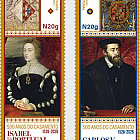
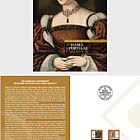
Daughter of King Manuel I of Portugal and his second wife, Queen Maria of Aragon and Castile, Infanta Isabella was born in Lisbon, at the Paço da Alcáçova, in 1503. Her elder brother, John, had been born in June of the previous year and would later succeed their father to the throne as King John III of Portugal. After Isabella came Beatrice (1504), Louis (1506), Ferdinand (1507), Afonso (1509), Maria (1511), Henry (1512), Duarte (1515), and António (1516). Before her death in 1517, at the age of 34, Queen Maria had borne Manuel I ten children, thus securing the continuity of the Portuguese royal house. Portugal was then enjoying a period of internal peace and prosperity, underpinned by the establishment of a transoceanic empire which, by the 16th century, extended across three continents, embracing the Atlantic islands, the Province of Santa Cruz, the dominions in the East, the African trading posts, and the Portuguese strongholds in Morocco.
Although male heirs naturally took precedence, royal daughters were invaluable assets in the complex game of dynastic alliances. By the end of 1515 it had become clear that the Portuguese sovereigns intended to marry their eldest daughter, Isabella, to Charles of Habsburg (b. 1500), the eldest grandson of the Catholic Monarchs and of Emperor Maximilian, at a time when the Austrian dynasty was poised to inherit the crowns of Castile and Aragon through Charles. Manuel I expressly recorded this wish in his will of 1517, urging his successor to bring the marriage to fruition. In time, Isabella herself seems to have embraced the maxim Aut Caesar aut nihil — “Either Caesar or nothing” — which is believed to have served as her personal motto before her marriage.
In 1518, following Queen Maria’s death and in the context of the political changes in the Iberian Peninsula with the accession of Charles of Habsburg to the thrones of Castile and Aragon, Manuel I married again, this time to Eleanor (b. 1498), Charles’s elder sister. This new dynastic bond influenced Manuel I’s peninsular politics when, in 1520, the Revolt of the Comuneros broke out in Castile. His political, financial, and logistical support for Charles proved decisive in suppressing the uprising, which challenged the legitimacy of the Habsburg ruler. Manuel I may well have believed that such support would also prove decisive in bringing about Isabella’s marriage. It was, however, during the reign of John III that the marriage alliance was finally concluded.
In 1525, at the Cortes convened in Torres Novas, the Castilian ambassadors and the King’s representatives signed the marriage contract, made possible by the exceptionally generous dowry that John III granted his sister, thus fulfilling the long-cherished ambition of “the Fortunate” — as Manuel I was known. The agreement was subsequently ratified by the Castilian Cortes in Toledo. The Portuguese court then departed for Almeirim, where, in the magnificent royal palace, the proxy marriage between Isabella of Portugal and Charles V took place on 1 November 1525. On 30 January 1526, Isabella set out for the frontier, accompanied by the King and a large retinue. The royal party reached Elvas on 5 February; the Castilian delegation was already waiting in Badajoz, whereupon the formal handover of the Infanta took place. On 11 March 1526, Isabella of Portugal and Emperor Charles V were married in a religious ceremony at the Royal Alcázar of Seville; though arranged for reasons of political expediency, the marriage developed into a genuine love match. Shortly after the marriage of John III to Catherine of Austria, the younger sister of the King-Emperor, the union of Isabella and Charles V further strengthened the dynastic ties between Avis Portugal and Habsburg Spain.
Ana Isabel Buescu,
Historian