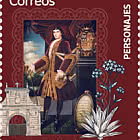
Don Fernando de la Campa y Cos was born on June 6, 1676, in the town of Cos, located in the municipality of Mazcuerras (Spain).
He arrived in Zacatecas (Mexico) accompanying his brother, serving as an assistant during military campaigns. There, he distinguished himself through his courage and bravery, rising rapidly through the military ranks until he was appointed Colonel of Infantry for the Spanish Crown.
In recognition of his contributions to the expansion of the territory of New Spain and his successes in peace-building endeavors, King Philip V granted him, on August 14, 1727, the noble titles of Viscount of the Valley of New Mexico (Vizconde del Valle de Nuevo Méjico) and Count of San Mateo de Valparaíso (Conde de San Mateo de Valparaíso).
He pursued a professional career in mining and livestock farming, which yielded significant profits a large portion of which he dedicated to funding social projects.
It could be said that Don Fernando de la Campa held sway over lands encompassing what are now the Mexican states of Zacatecas, Durango, San Luis Potosí, and Guanajuato. He owned 36 *haciendas* (estates) and 22 churches; some of these churches now serve as parish churches in various municipal seats.
Distinguished by his noble and charitable character, he enjoyed great prestige among the inhabitants of Zacatecas. He was a promoter of education both in his birthplace of Cos and in Zacatecas as well as a prominent patron of the arts and a benefactor to numerous schools, seminaries, convents, and other institutions. Don Fernando de la Campa served multiple times as mayor of the city of Zacatecas. He dedicated himself wholeheartedly to the city’s beautification, contributing significant sums from his own personal wealth to fund and construct vital infrastructure including convents, schools, churches, the city’s aqueduct, and its cathedral.
In Mexico City, two palaces belonging to the Counts of Valparaíso stand out within the historic center. One now serves as the headquarters for the National Bank of Mexico (BANAMEX), while the other known as the Palacio Iturbide has functioned since 2004 as a cultural center under the auspices of the same bank.
In Fresnillo, the Sanctuary of Plateros was established thanks to the Count of San Mateo; it is the third most significant pilgrimage site in the region, dedicated to the veneration of the *Santo Niño de Atocha* (Holy Child of Atocha).
Today, his contributions to the beautification of sites such as the historic centers of Mexico City and Zacatecas, as well as the *Camino Real de Tierra Adentro*, have been recognized through their designation as UNESCO World Heritage Sites.
Don Fernando de la Campa y Cos left behind a substantial architectural and cultural legacy in Mexico; furthermore, his descendants played a role in the emergence of Mexico as a nation independent of the Kingdom of Spain. From his first marriage to María Rosalía Dosal Lamadrid, two daughters were born. His firstborn, María Ildefonsa de la Campa, married Andrés Sanchez de Tagle y Valdivieso, a native of the Cantabrian town of Santillana del Mar. The great-grandson of this union, Francisco Manuel Sanchez de Tagle, was an illustrious politician, writer, and lawyer who helped write some of the most brilliant chapters in the history of the nascent Mexican nation; he drafted the Mexican Declaration of Independence which he also signed promulgated on September 28, 1821, and he likewise drafted the first Federal Constitution of the United Mexican States in 1824. On October 7, 1821, as a member of the Provisional Governing Junta, he headed the commission that determined the design and colors of the national flag, as well as the nation’s coat of arms both of which were approved by the Junta on November 2. To this day, despite various modifications the national coat of arms has undergone, this original proposal has remained the foundation for the design we use today.