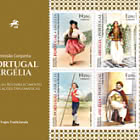
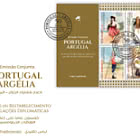
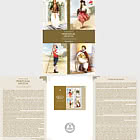
Traditional dress constitutes a living memory of its people, embodying their identity and expressing the depth of their cultural heritage, whilst also serving as a bridge for dialogue and engagement between cultures. In this context, the joint issue by Algeria and Portugal highlights the Karakou El Assimi, the Arabic Costume, the Seven-Skirt Costume of Nazaré and the Ribatejo Campino’s Costume as important expressions of Algerian and Portuguese cultural heritage.
The Karakou El Assimi is one of the most exquisite traditional Algerian female costumes and one of those most deeply associated with the cultural identity of Algiers; it also plays a prominent role in the Algerian bride’s traditional attire. It consists essentially of a short, close-fitting jacket, usually made of velvet and adorned with traditional gold embroidery, notably using the medjboud and fetla techniques, which bear witness to the precision, skill and mastery of Algerian craftspeople. The Karakou is usually worn with traditional trousers, notably the mdouar saroual and the chelka saroual. Over time, and in line with changing tastes and trends, the Karakou has undergone a number of changes in its cuts and styles, whilst retaining its traditional essence. This ability to adapt has made it a source of inspiration for contemporary fashion and haute couture.
The Arabic Costume is one of the most important symbols of traditional men’s clothing in Algeria, representing dignity, elegance and a sense of belonging to an ancestral heritage. This costume has retained its place at various religious, national and social occasions.
The Arabic Costume is made up of a harmonious set of garments that combine elegance and comfort. Among its main elements are the Arabic saroual, also known as the bel hjar saroual or mestef saroual loose-fitting, wide-leg trousers designed to allow freedom of movement, make sitting easier and enable horse riding. The outfit also includes the waistcoat or badia, a sleeveless garment with buttons and two small pockets, worn over the Arabic shirt, or qamja, which is characterised by its length, the simplicity of its cut and its long sleeves made from a light, soft fabric. The ensemble is completed by the jacket, popularly known as a veste, with long sleeves, buttons and pockets, giving the outfit its harmonious, distinctive and elegant appearance.
The Seven-Skirts Costume of Nazaré is associated with the number seven, which has various symbolic connotations deeply rooted in Portuguese culture and traditions. According to popular belief, the seven skirts represent the seven waves of the sea, where the seventh is associated with the strongest wave and symbolises the period of waiting and anticipation for the safe return of the fishermen.
The number seven is also associated with the seven days of the week and the seven colours of the rainbow; each skirt features a different colour or shade, giving the costume a unique character steeped in symbolism. The number seven also has a profound spiritual and religious significance in local traditions; it is linked to the religious heritage and holds a place of particular symbolic importance.
The Ribatejo Campino Costume, traditionally associated with men who work with and tend to livestock, is not merely a festive or folk costume, but it is also an important expression of the cultural identity and rural history of the Ribatejo region in Portugal. It reflects the nature of country life, the social status associated with the profession, as well as the courage and skill required to handle cattle and the bulls used in bullfighting. Every element of this costume, including the colours, fabrics, details and ornaments, has a historical and cultural significance linked to rural life and work in the Portuguese lezíria the fertile alluvial plains stretching along the River Tagus.
The relationship between the campino and the world of bullfighting is close and deeply rooted in rural traditions. The campino is not merely a folkloric figure or a traditional symbol; he is the one who breeds, cares for, tends and herds the bulls in the Lezíria of Ribatejo, long before they reach the arena. As such, the Campino’s Costume represents the rural heritage of the Ribatejo, the courage and skill of the traditional horseman, and the deep connection between man, the land and the cattle fundamental elements of Portuguese cultural identity.