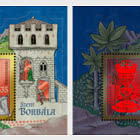
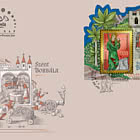
Magyar Posta is issuing a unique special souvenir sheet in honour of Saint Barbara, one of the fourteen Holy Helpers. Twenty thousand copies of this philatelic special issue, designed by Imre Benedek, were produced by Codex Értékpapírnyomda Zrt. The new issue will be available at first day post offices and Filaposta in Hungary from 4 November 2026, but may also be ordered from Magyar Posta’s online store.
Barbara is the feminine form of the name Barbarus, originally meaning savage and later pagan. One of the most important and most popular female saints in Christian cultural history, Saint Barbara was born in the second half of the 3rd century in Nicomedia, Asia Minor, in present-day Türkiye. Internationally, she is known as Saint Barbara, and, in Orthodox Christianity, she is venerated as the Great Martyr Barbara, while in Hungary the local variant of her name, Borbála, is used. Saint Barbara is the patron saint of miners, metallurgists, artillerymen, builders, military engineers, and cannon and bell founders, a Christian martyr and one of the Fourteen Holy Helpers. Barbara’s pagan father guarded her jealously, and locked her in a tower to protect her from the outside world. During her captivity, she converted to Christianity in secret and, when her father was away, out of reverence for the Holy Trinity, ordered that a third window be inserted in the tower wall in addition to the two existing ones. Upon his return, her father discovered his daughter’s faith and, in his rage, began to persecute her. Legend has it that, when Barbara fled, a rock face opened and gave her shelter from the wrath of her father. Eventually, it was her own father who turned her over to the Roman authorities, who, after torturing her cruelly, sentenced her to death. While in prison, Jesus appeared to the suffering young woman, comforting and strengthening her as her heavenly bridegroom and her wounds left by the torture vanished from her body. The next day, after she prayed, an angel of God covered the innocent virgin’s body with a robe. Finally, she was beheaded by her own father. Barbara was buried by a Christian, Valentinus. Immediately after executing his daughter, the saint’s father was struck dead by a bolt of lightning. Due to this association, Saint Barbara is appealed to for protection against sudden death, lightning, explosions and underground dangers. Her feast day, 4 December, is still reverently observed by miners and artillerymen to this day. Her tomb became the site of miracles. Source: Magyar Kurír - katolikus hírportál
The stamp design and the postmark both depict Saint Barbara in her traditional iconographic form: she is holding a palm branch and a chalice containing the Holy Eucharist. On the stamp, a sword can also be seen lying at her feet. Scenes relating to the legend of Saint Barbara appear in the background of the souvenir sheet. A special feature of the souvenir sheet is that the stamp itself can be peeled back and, when unfolded, one of Saint Barbara’s attributes, the chalice (ciborium), appears in the space below the stamp. Another special feature of the souvenir sheet is that, under UV light, the chalice appears in the stamp design, and, when the stamp is peeled back, the figure of Saint Barbara becomes visible on the underside, whilst further motifs emerge in the frame design. The first day cover shows some of the professions whose patron saint is Saint Barbara.