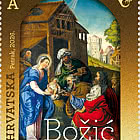
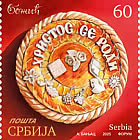
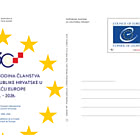
Croatia’s Christmas heritage is truly rich. This most cherished holiday of the year has inspired many painters, sculptors and woodcarvers, from modest Nativity scenes in village chapels to sumptuous altars in churches and cathedrals, and from simple homemade cribs to masterpieces by great artists. This year’s Croatian Post’s Christmas stamp, which seeks to uncover and present the Christmas heritage of all regions of Croatia, features a painting from the main altar of the Church of the Three Kings in Komin, in Croatian Zagorje.
Everything associated with the Three Kings carries with it something joyful, a childlike thought of gifts. Our first thoughts are not so much of the symbolic value and meaning of those gifts, the metaphysical dimension of the distant lands from which the Kings come and to which they return, the kinship between Earth and the cosmos or the prophetic guidance of the star. All of this belongs to the mythical and historical significance of the holy Magi. Yet the first thought evoked by the Kings is of something radiant and golden, something eagerly awaited, a joy and a surprise that someone has secretly, but surely, prepared for us.
The church in Komin itself has the qualities of just such a gift. It is encircled by an arcaded enclosure wall, framing its sacred space like a ribbon around a precious box. Inside, everything abounds with expressions of joy and imagination. The church was first built in 1669, during the episcopate of Bishop Borković, and gained its present form and interior in 1729, during the time of Bishop Branjug, renowned for his work on the episcopal palace in Zagreb and for his patronage of the well-known woodcarving workshop that bears his name. The church interior is an example of sumptuous Baroque art and one of the most representative examples of its style and period in Croatia. The Christmas theme of the Adoration of the Kings appears several times within the church on the wall frescoes, on the pulpit and, most importantly, in the painting that forms the centerpiece of the lower section of the magnificent, gleaming and exuberantly decorated main altar.
The painting is the work of an unknown artist and, like the main altar itself, dates from the year of Branjug’s remodeling of the church. With its depth of landscape, treatment of light and wealth of detail, it appears almost like a page from Les Très Riches Heures du Duc de Berry. In any case, it is filled with echoes of earlier artistic traditions. It also lacks the gentle curves of the Baroque; in the minute details of the goldsmiths’ work the gifts carried by the Kings one can almost sense the spirit of the preceding century, as well as in the hairstyle of the dark-haired King. The unusual architecture beside which the scene of the Adoration unfolds is composed entirely of strict, straight lines. The very steep roofs of the houses in the background give the scene a northern character, while the stone tower beside them recalls a more southerly sixteenth-century architectural repertoire, such as the Belém Tower. The subtle gradation of light allows the star to remain visible and radiant while the landscape stretches out clearly into the distance. With a graceful eclecticism, the artist moves through different places and periods, allowing us to take in the painting slowly, to linger within it with curiosity and for a long time.
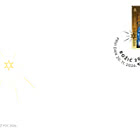
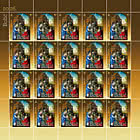
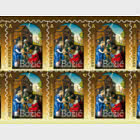
Christmas returns and the Kings are coming. Along with the gifts we always hope for, they bring one more, a very small one: their stop in Komin along the way, now captured on Croatian Post’s Christmas stamp.
Academician Željka Čorak