Christmas
| Set |
| Miniature Sheet |
| Sheetlets |
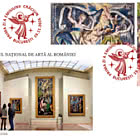
| First Day Cover |
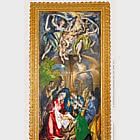
| Special Folder |
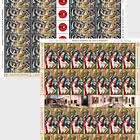
| Full sheets |
Christmas, one of the most beloved and luminous feasts of Christendom, brings each year the joy of remembering the Nativity of Our Saviour Jesus Christ, an event which, over the centuries, has inspired some of the most valuable creations of world art. In painting, the theme of the Nativity of the Lord has become an expression of faith, hope and divine love, interpreted by great artists of the world in works of profound spiritual sensitivity.
On the occasion of the winter holidays, Romfilatelia and Romanian Post dedicate the postage stamp issue ‘CHRISTMAS 2026’ to one of the masterpieces of European religious painting, The Adoration of the Shepherds, by the renowned painter El Greco, an artist whose work holds a special place in the history of world art.
Among the paintings that form the core of the European Art Gallery of the National Museum of Art of Romania, The Adoration of the Shepherds, painted by El Greco and of rather unusual dimensions (346 × 137 cm), is a remarkable case, both because of the convergence between King Carol I’s personal taste and the spectacular rediscovery of the famous Cretan painter towards the end of the 19thcentury, and from the perspective of the history of the artefact itself, from the circumstances in which it was created to its inclusion in the royal gallery in Bucharest.
The painting was part of the first selection of works of art acquired by Carol I in 1879 from the collection of Consul Felix Bamberg, a group of works around which the royal collection grew in the following decades. The painting’s journey began in 1810, with the dismantling of the polyptych altarpiece to which it belonged; on its way to Bucharest, it stopped in Paris for several decades.
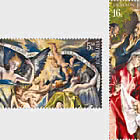
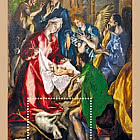
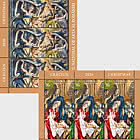
The philatelic issue, consisting of two postage stamps (with the face values of Lei 5.50 and Lei 16), a perforated souvenir sheet (with the face value of Lei 32), a First Day Cover and a philatelic folder with a special product in a limited print run, will be introduced into circulation on Thursday, November 19th, 2026.
El Greco (1541–1614), whose real name was Doménikos Theotokópoulos, was born on the island of Crete, where he began his artistic training under the influence of the Byzantine tradition. Later settling in Italy, in Venice and Rome, the painter assimilated elements of the Italian Renaissance, gradually developing an original artistic language. In 1577 he arrived in Spain and settled in Toledo, the city that was to become the centre of his creative activity and where he was to pass away.
A remarkable artistic personality, El Greco made his mark through an unmistakable style, characterised by the expressive elongation of figures, dynamic compositions, intense colour and the use of light as a means of expressing the transcendent. His work, at the crossroads of the Byzantine tradition and the art of the Renaissance and European Mannerism, anticipates, through the force of its expression, some of the concerns of modern painting.
The Adoration of the Shepherds was executed between 1596 and 1600 for the high altar of the College of Doña María de Aragón in Madrid, founded by the friar and theologian Alonso de Orozco. His religious meditations influenced the conception of the ensemble, and El Greco found here a fitting setting for his singular and deeply personal artistic language.
The work in Bucharest constituted the left wing of the altarpiece and stood alongside The Baptism of Christ and The Annunciation. The ensemble was dismantled in 1810, during the Napoleonic occupation. Of its seven paintings, five are now in the Prado Museum in Madrid, one is here, and the last has been lost.
At the centre of the composition, the Holy Child, lying on a white cloth, radiates a supernatural light that illuminates the faces and garments of the figures around Him. Light, an essential element of the artistic construction, becomes the symbol of the divine presence and of the hope brought to humanity through the Birth of Christ.
The Virgin Mary, portrayed in an attitude of deep tenderness and contemplation, gazes at the Child, while the shepherds, captured in gestures of wonder and adoration, express the emotion of encountering the divine miracle. The elongated figures, sweeping movements and colour contrasts heighten the intensity of the spiritual experience.
In the upper part of the painting, angels complete the earthly scene with a heavenly presence, suggesting the communion between the world of humankind and the divine kingdom. The entire composition seems animated by an upward movement, characteristic of El Greco’s artistic vision, through which visible reality is transformed into an expression of the mystery of faith.
Unlike traditional depictions of the Nativity, in which calm and harmony prevail, El Greco gives the scene a remarkable inner drama. The figures are not mere characters in a biblical narrative but participants in a spiritual revelation, and the light emanating from the body of the Child symbolises the triumph of good over darkness.
Through the depth of its religious message and the originality of its artistic expression, ‘The Adoration of the Shepherds’ ranks among the great masterpieces of sacred painting, illustrating in a deeply moving way the encounter between the human and the divine.
The philatelic issue ‘Christmas 2026’ highlights the beauty and significance of this work of art, bringing a message of faith, peace and hope into the miniature world of the postage stamp. The reproduction of such a masterpiece on postage stamps underlines the role of philately in promoting the universal cultural heritage and in bringing the public closer to the great creations of humanity.
Through its profound symbolism, the image of ‘The Adoration of the Shepherds’ reminds us that the true light of Christmas is found in love, humility, generosity and solidarity, values that transcend time and unite generations.
Romfilatelia extends to all collectors and lovers of beauty its wishes for health, peace and joy, in the blessed light of the Holy Christmas Holidays!
Romfilatelia thanks Mr Erwin Kessler, General Manager of the National Museum of Art of Romania, and his team of specialists for their documentary support provided in the development of this postage stamp issue.
Romania - Recommended stamp issues





WOPA+ recommended stamp issues


| Avatar - Fire and Ash |
| Issued: 03.12.2025 |
| ›New Zealand |

| 50th Anniversary of the Founding of the 24th November Bar Scout |
| Issued: 24.11.2025 |
| ›Montenegro |
| Krisjanis Valdemars |
| Issued: 02.12.2025 |
| ›Latvia |

| Sign Language - Good |
| Issued: 02.12.2025 |
| ›Bosnia and Herzegovina - Republic of Srpska |

| In Memory of the Fallen and Murdered on October 7, 2023 |
| Issued: 08.10.2025 |
| ›Israel |


| Annual Collection Folder (New York) |
| Issued: 05.12.2025 |
| ›United Nations |

| Year Set |
| Issued: 24.11.2025 |
| ›Isle of Man |
| Shipping in the 17th and 18th Centuries - Peat Shipping |
| Issued: 05.12.2025 |
| ›Netherlands |