2012Art – Arhitecture - First Day Cover
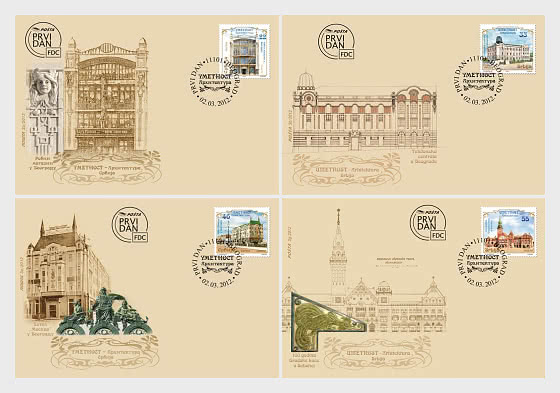
- 02.03.2012
- Nadežda Skočajić, graduated graphic artist
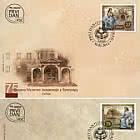
The department store in Kralja Petra Street number 16, in Belgrade is pronouncly vertical, harmonious, and has beautiful proportions. It represents the most successful and most pure example of Secession architecture in Belgrade. It was built in 1907, in those days main trade street, according to the plans of architect Victor Azriel. It was built for Bencion Buli, famous banker and representative, as the first modern department store in Belgrade, completely different from traditional stores. The specific purpose of the building enabled the architect to treat the interiors and use modern constructions much more freely. This fairly small building has a cellar and four floors of which the ground floor, midfloor and first floor represent a unique selling space, and the highest floor is dedicated to the storage.
This department store was the first trade building in Belgrade, in which several floors were mutually connected and open. This open space was achieved with the use of columns, galleries, and an iron bridge that passed through the central space in the height of the first floor, lightened by the façade and rectangular lanterns from the flat roof. The highest floor is completely separated with an iron ceiling and dedicated to storage, and offices are in the back part, just behind the selling space. The architectural program of the department store is depicted with the Secession style façade. Done as a glass “wall-curtain” and held by an iron bar, the façade is located between two marble pillars with characteristic endings - decorative elements in the shape of prisms. White pillars on black polished granite bases, decorated in relief, with naturalistic female masks with undone hairs, from which slope down stylized geometrical strips. The arc ending of the façade, as well as the iron balcony fence, which, by its position, bisects the building into two parts, are done in moderate Secession style. Symmetrically set and with a trapezoid base, the portal with doorknobs in the shape of swans is located in the central part of the ground floor. This zoomorphological detail, along with anthropomorphic female masks, geometrical strips and interlaced floral elements represent the decorative repertoire of the department store. Thanks to the architecture of the store department, the city of Belgrade kept pace with the times. Its constructor introduced the Secession style in the architecture of the Serbian capital almost at the same time when it was up-to-date in other countries. By applying all elements of “Art Nouveau”, Victor Azriel drew up the plans for this, nowadays lonely architectural concept, which was declared cultural property in 1966.
Telephone Exchange Building in BelgradeThe beginning of the 20th century and the emergence of Secession marked for Serbia the start of national Romanticism, which clearly reflected in the field of construction. One of the structures that can be interpreted as a discovery of the desired Serbian Byzantine style was the main telephone exchange building in Kosovska Street.
The architectural design was made by the architect Branko Tanazević (1876-1945), the most prominent representative of the national style in Serbian architecture in the first half of the 19th century.
The construction of the building in the Kosovska Street started in 1908, and the telephone exchange started working in 1910.
The main façade faces the Parliament Park, and its dominant part is on the right side, next to the neighboring building. The parallel to this risalite (the dominant part), is the corner of the building with sets of three extremely large windows on each floor and a monumental fini-shing decoration developed in three mild arches, with a hollow dome typical for Secession. The national marking on the building are before all the decorative elements based on the Moravian School style. The building is characterized by strong coloristic accents. Namely, the neutral façade carries decorative elements made from bricks fired to a strong color.
The ground floor is dominated by two colored horizontal lines, while the first and the second floor are connected with vertical decorative elements. The building construction however, has marks of acade-mism. Since the number of offices did not satisfy the needs of the postal and telegraph service, the officials proposed an additional floor to be constructed in 1919. The building was finished in 1925 and has kept its shape until today.
Hotel „Moskva” in BelgradeThe Moskva Hotel was the first construction project that marked the future construction of the Terazije square. In the early 20thcentury, the Insurance Company ”Rossia“ from St. Petersburg, bought land at the corner of Kralja Milana (today Terazije square) and Balkanska Street, in order to build a facility for its company. In 1905. the Company announced the open competition for the construction of the building. The first prize and the right to realization, won the work of architect Viktor Kovačić from Zagreb. However, the management of the Company in St. Petersburg disagreed with the decision of the jury, and accepted the design of Jovan Ilkić, awarded the second prize. Architect Ilkić was invited to St. Petersburg, where the work on the design was continued in cooperation with Russian architects. The design was signed by the architect Pavel Karlovič Bergštreser, ”head-architect“ of the Insurance Company ”Rossia“. The Moskva Hotel was realized under the supervision of Jovan Ilkić. Freed of traditional compositional procedure, by the used type of decoration and by the use of new materials such as Swedish granite, reinforced concrete, faience, marble and ceramics, it is among the first examples in Serbian architecture on which was accepted the Secession style. Green ceramic tiles which made a special decorative colourful façade formwork, were designed in the famous factory of maiolica and ceramic ornaments ”Zolnaj“ from Pecs. Decorative motifs on the façade were made according to Ilkić’s design. Significant details of the hotel’s façade and its ornamental assemblage are represented by the sculpure ”Woman with Three Children“ as well as by ”Glorification of Russia“ allegorical relief representation of economic and naval forces of Russia, made in maiolica style. The Palace of the Insurance Company ”Rossia“ with a café and the Moskva Hotel, was opened by King Petar I Karađorđević on January 14, 1908.
Soon afterwards, the Hotel became the headquarters of the Journalists and Writers Association. In 1910, this was the place where the Olympic movement was founded in Serbia. In 1923, the first post office windows of the Postal Savings Bank were open here, and in the post-war years regular guests of the Hotel were, among others, Ivo Andrić and Vasko Popa. In the first 100 years of its existence, it had more than 36 million visitors among which Nikola Pašić, Albert Einstein, Jean - Paul Sartre, Alfred Hitchcock, Miloš Forman, Indira Ghandi, Luciano Pavarotti, Orson Welles, Ray Charles, Carl Lewis, Jack Nicholson and many others. By the middle of the 20th century, the building was declared cultural monument under state protection.
100 Years of the City Hall in SuboticaThe City Hall is certainly the most important building in Subotica. It was built as a result of two hundred years of effort to transform a wild and unsuitable living environment into a milieu convenient not only for living, but also for a first-class spiritual, aesthetic and artistic experience. In that period, Subotica was part of the Austro - Hungarian Empire. Today’s City Hall is the third built on the same location. The first City Hall was built in 1751, the second between 1826. and 1828, and the plans for the third were made in 1896, but they were not realized.
In 1902, the ambitious Karolj Biro became mayor of Subotica. Some of the most important city buildings from the beginning of the 19th century were built under his supervision. An open competition for the construction of the City Hall was announced on August 30th 1906. One of the conditions of the competition related to the construction style which had to be baroque in the honour of the Habsburg Empress, Maria Theresa. The city enjoyed the free royal city status bestowed upon it by the Empress. The first prize at the competition won architects from Budapest, Marcel Komor and Deže Jakab, who went in front of the senate with the suggestion to build a City Hall in Secession style instead of baroque, which would reduce building expenses.
So, until June 1908, new plans were approved for the City Hall and its construction began. At the same time, in the Romanian town Targu Mures, a City Hall was being built in the new style, according to the plan of the same architects. Rough works were completed until 1910, but they needed two more years to complete the interior works designed by the hand of Deže Jakab. The then constructed building was 105,08 m long and 55,56 m wide, with the basic area of 5.838 m2 and 16.000 m2 of useful area. It was a modern building by its function, as well its equipment; it had plumbing, sewerage system, central heating and elevator, which led from the official entrance to the third floor.
The City Hall was finished in 1912. as an omen of the New Age, and administration house in the service of the citizens. Its rich Secessionist decoration, inspired by folklore motifs of embroidered parts of national costumes and architecture from Transilvania, on the façades, and especially in the interior, through symbolic reviews are presented characteristics of the whole those days way of life in Subotica.
Serbia - Recommended stamp issues



WOPA+ recommended stamp issues

| Avatar - Fire and Ash |
| Issued: 03.12.2025 |
| ›New Zealand |
| 50th Anniversary of the Founding of the 24th November Bar Scout |
| Issued: 24.11.2025 |
| ›Montenegro |
| Krisjanis Valdemars |
| Issued: 02.12.2025 |
| ›Latvia |


| Sign Language - Good |
| Issued: 02.12.2025 |
| ›Bosnia and Herzegovina - Republic of Srpska |

| In Memory of the Fallen and Murdered on October 7, 2023 |
| Issued: 08.10.2025 |
| ›Israel |

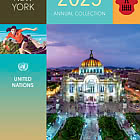
| Annual Collection Folder (New York) |
| Issued: 05.12.2025 |
| ›United Nations |
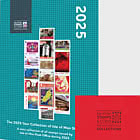
| Year Set |
| Issued: 24.11.2025 |
| ›Isle of Man |
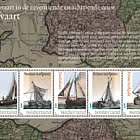
| Shipping in the 17th and 18th Centuries - Peat Shipping |
| Issued: 05.12.2025 |
| ›Netherlands |