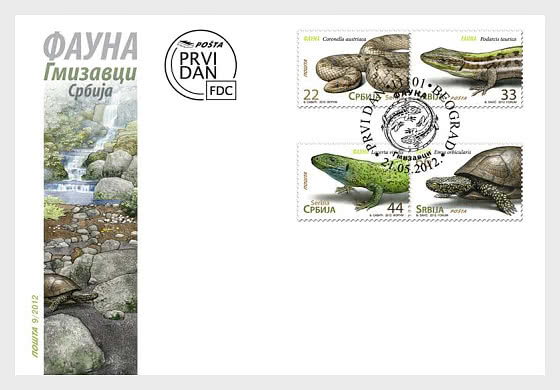
Reptiles (lat. Reptilia from reptilis - the one which crawls) played an extremely important role in the evolution of the animal world, because they represented the first group of vertebrates that completely went ashore. This was enabled by the development of the egg’s membrane and eggshell, which protected them from drying out. Their body is protected with horn scales and / or plaques, that protect them from loosing liquids, and they breathe solely via lungs. The fertilization is internal and most reptiles are oviparous (lay eggs), although a large number is also vivipary (live birth). The ability of regenaration is well developed and they are very resistant animals except to low temperatures. They can go a very long time without food; some snakes, for example, for more than one year. They are among the most long-lived animals on our planet. The most known extant groups of reptiles are: turtles, lizards, snakes, crocodilians, alligators and gavials.
Smooth snake - Coronella austriaca is a relatively small snake, not bigger than 80cm, with a very short head, round pupils and smooth skales. It has a brown / reddish brown or gray colouring, with dark square spots on the back. It can be found in dry habitats, but in Southern parts of Serbia it also inhabits more humid and relatively colder regions, on higher altitudes. It feeds primarily on lizards, rarely on small mammals.
Steppe lizard - Podarcis taurica can grow up to the size of 24cm, of which two thirds make up the tail. Its back is green, with two bright and fine lines on both sides with dark marble spots between them. It inhabits dry, mostly plain habitats of open type in Southwest, South, Southeast and Eastern Serbia and Vojvodina.
European green lizard - Lacerta Viridis is a large lizard distributed across Europe. It reaches more than 35cm in length. The tail can be up to twice the length of the body. Males have a uniform green colouring pronounced upon its back and females may be brownish or green brownish. Males have a characteristic turquoise blue colouring of the neck, which is very pronounced during mating. It is widely spread in Serbia. It mostly feeds on invertebrates, but also bird eggs, fledgling and sometimes fruits.
European pond turtle - Emys orbicularis is the most widespread freshwater species in Europe. It can grow up to the size of 30cm. Its shell is black with bright radial, in most cases yellowish broken lines that spread from the centre towards the periphery of the bony plaques. In Serbia it is mostly a depression species, but it can also be found in suitable habitats up to 1000m above sea level. This species is grasping and mostly feeds on water invertebrates, amphibians, fishes, plants, but also dead animals. Life span is 40 years.