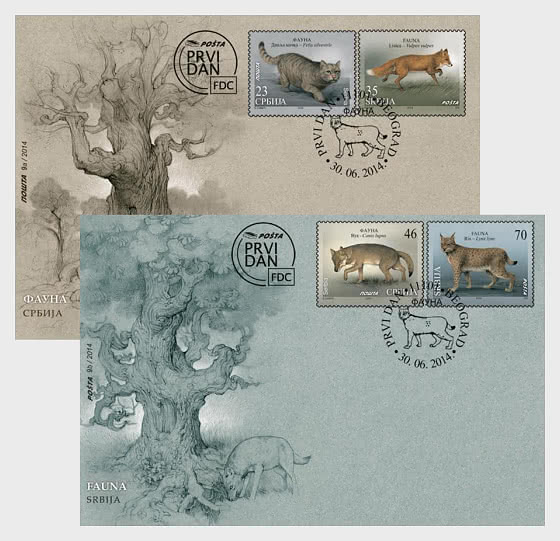
Wild Cat Felis Silvestris – The wild cat is the smallest European representative of cats. Though it is often thought that the domestic cat has resulted from taming thereof, it is completely wrong because the domestic cat origins from the early tamed North-American cats and proofs thereto have been found in the remainders of the ancient Egyptian culture. Nevertheless, given that the word is about related types, hybridisation of the domestic and wild cat occurs very often nowadays because domestic cats are more and more numerous in the nature as the feral ones. The wild cat is a typical forest type of mammals which more difficultly gets accustomed to the vicinity of the man using more often hidden places of some abandoned buildings out of settlements, as their burrows. They bring forth up to 4 youngs and live in much hidden way. They feed with birds and small mammals which they catch very skilfully. The wild cat is classified into protected types which are protected in Serbia by a hunting-closed-season as from 1stMarch till 30th June, whereas in Vojvodina it is strictly protected and the hunting-closed-season is prescribed throughout the whole year.
Fox Vulpes Vulpes – For the hunters it is a pest, for the naturalists an industrious sanitary worker. The fox belongs to the family of dogs and order of beasts and as such it is the most numerous among them. Its primeval habitation is forest, but it has adjusted to the life in the vicinity of the man because close to him it more easily comes to abundance of food. They live in burrows they find or they dig by themselves. They do not form packs but only aggregations which are created by usage of common shelter. In the brood there may be about 7 youngs. The fox has long time ago, in search of food, started living immediately close to the man, especially because of eatable organic waste the man piles up in his environment, but also because of availability of cattle, particularly of poultry. As rarely as any other type, but based on its biology, large number and ecological role in the nature, the fox in Serbia has not been classified in the lists of protected types for a long time, and especially it has not been protected by a hunting-closed-season. Although it has recently got such status, however, it may be hunted during the whole year. It is a main reservoir and transmitter of rabies in the nature. Because of that, in Serbia recently has started application of oral vaccination in the nature against this dangerous zoonosis.
Wolf Canis lupus - It is the greatest representative of the family of dogs in Europe. Lives in packs where there is precisely defined hierarchy all the members stick to, which is reflected in existence of a dominant couple and their followers of different levels, common hunting, sequence of feeding and other manifestations. They are brought forth in burrows and there could be 6 youngs in one brood. Settlement of wolves is usually in the forests of hilly terrains and mountains which offer sufficient places for hiding. Their food is meat and offals, first of all those of mammals. Their preys are members of the most available types, but their favourites are the Ungulata – the roe-deer and deer and they gladly eat carcasses. They regularly make damage to the domestic animals if they are enabled by a traditional way of keeping and holding cattle. That’s why the wolf is disliked among village inhabitants, particularly among cattle breeders. Due to that reason they often become a target of hunters, although hunting of wolves is not that simple and often, because the wolf is a master of avoiding the man and his chases. After the Second World War population of wolves in Serbia was significantly reduced in number because of use of poisonous bites. After the usage of poison had been forbidden, the population has gradually recovered and nowadays in Serbia there live about 1000 specimens. Males may be hunted during the whole year and females and youngs as from 1st July till 28th February. In Vojvodina, it is strictly protected in some parts of the province.
Lynx Lynx Lynx - This is the biggest European cat. It lives a hidden life in hardly accessible hilly and mountain forests, especially those ones that are rich in pastures, clearings and rocks. The lynx is a loner and more specimens may be seen only in the period of copulation and during the period of growing-up of youngs when they, with their mother, make a family group. They copulate in February; bring forth up to four youngs in April and the youngs leave their mother a little while after a year of age. They eat meat of available mammals and birds and their most often preys are roe-deer, wood hens and chamois. In Serbia, cases of damage caused by lynx are almost unknown. In many countries the lynx is permanently protected type and only in some countries it is protected by a hunting-closed-season. In Serbia, the lynx has been permanently protected for a long time and is classified within the strictly protected types. In the South-Western parts of the country there live members of the Balkans population which is likely to lose the battle with time and man and is on the brink of survival. In the Eastern parts of Serbia there live members of the Carpathian Mountains population perspective of which is bright because their areal and number are increasing.