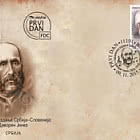
2015Famous Serbian Directors - First Day Cover
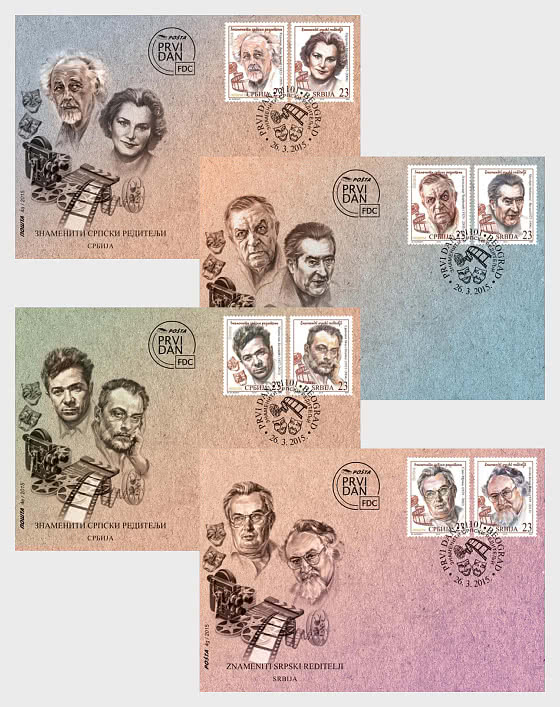
- 26.03.2015
- MA Marina Kalezić, academic painter
Radivoje “Lola” Đukić, director and writer, born on 3rd April 1923 in Smederevo. Lived in Belgrade, where he finished his studies at the Film School. Worked as a director in Radio Belgrade and Television Belgrade since its foundation. Was the founder of the Humorous Theatre on Terazije in Belgrade, as well as its first director.
Wrote and directed theatre plays such as: Gold Mine, God Has Died in Vain, Budibogsnama, A Man with Four Legs, I must kill Peter, Happy Makers, I Steal, You Steal, They Steal, One Love and Five Dead Men, and the musical Kill or Kiss.
He left behind hundreds of satirical features made for TV Belgrade. He wrote and directed over 200 shows. The works he authored include the TV series The Mirror of a Humble Citizen, Black Snow, Ten Commandments, I Will, You Will, He Will. With Novak Novak, he co-wrote Service Station, On Secret Channel, Wax Museum, Face to Reverse, Sleep Tight, Sačulatac.
He directed the following feature films: Lake, The Ballad of the Cruel One, Greek Children, There Are No Small Gods, A Bag of Luck, The place! Obedient citizen, Golden Sling.
He wrote the books: Sclerotic Memoirs, Sheep on the Boulevard of the October Revolution, Fools eat fog, A Man with Straight Back in the Land of the Hunchbacked. In addition to directing and writing, Radivoje “Lola” Đukić was also a painter. He won many awards: Order of Labour with Red Banner, Order of Brotherhood and Unity with Golden Wreath, Charter for the Construction of Belgrade, and the award by SFERA from Zagreb for the best Science Fiction novel. He died in Belgrade in 1995.
Ognjenka Milićević, director, theatrologist, professor, essayist, born on 26th December 1927 in Banja Luka. She studied directing in Saint Petersburg and at the Academy of Theatre in Belgrade. Graduated in 1952. Worked as director in the National Theatre in Sarajevo, Belgrade, Mostar, including the theatre Atelje 212 in Belgrade, where she directed plays such as: Deep Are the Roots, Romulus the Great, Trees Die Standing Tall, The Trojan Women. In addition to her theatre work, she directed many plays for Radio and Television Belgrade. She was the author of over 100 essays and two studies on theatre: Russian Theatre in the First Half of the 20th Century and On Meyerhold’s Theatre. She was Professor of Directing and Dean of the Faculty of Dramatic Arts. She was also Pro-rector of the University of Arts. For her work, she was awarded numerous awards and honours, including the Grand Medallion of the University of Arts. She was awarded the Order of Merits for the People. Ognjenka Milićević was also a member of the Yugoslav volleyball national team. She died in Belgrade in 2008.
Aleksandar Đorđević was born on 28th July, 1924 in Subotica. Graduated directing from the Academy of Theatre in Belgrade in 1952, in the class of professor Hugo Klajn. Directed a number of plays in the National Theatre in Niš from 1952 to 1961, when he joined the staff of Television Belgrade, where he worked until 1990.
Directed over 200 plays in theatres throughout Serbia, including the Belgrade theatres: JDP (Yugoslav Drama Theatre), Theatre on Terazije, Atelje 212, Boško Buha Theatre. The best known out of these plays were: The End of the Weekend, Fiddler on the Roof, Poltron, Eternal Student, Yalta – Yalta, The Lover. He also directed eight feature films: The Written Off Return, Let’s Fall in Love, Jaguar’s leap, Valjevo train, as well as several TV plays: Mister Seal, Friendship, The Ancient Trade, The cork that is stopping the water. Television audiences remember him by the TV series: Written Off, The return of the Written off, Warm Wind, A Better Life, Happy People, Singles, Lefties.
He won a number of awards for his work: at the TV festival in Bled (1969), Hollywood TV festival (1972), festival in Portorož (1974), the Lifetime Achievement Award of Radio-Television Serbia (1978), the October Award of the City of Belgrade (1984); he was awarded the Order of Labour with Golden Wreath twice, as well as the Order of Bravery. He died in Belgrade in 2005.
Slavoljub Stefanović – Ravasi, born on 29th June 1927 in Čačak. Graduated directing at the Academy of Theatre in Belgrade in 1952, in the class of professor Hugo Klajn. Director of Provincial Theatre in Priština from 1952 to 1957. Directed both Serbian and Albanian plays. The first play he directed was All My Sons by Arthur Miller (1952). In 1957, he joined the staff of Radio Belgrade, and in 1958 he started working for TV Belgrade. The first TV play ever broadcast by Television Belgrade, in 1959, was directed by Ravasi, who also wrote the screenplay based on the play Rental Fee by Branislav Nušić. During his lifetime, he directed 84 television plays and series: At the Magistrate, People, Love Each Other!, The Chronicle of a Small Town Cemetery. He directed his last play, Tesla, in 1993. He also directed feature films, and his best known film is Koštana (1976). He was director or guest director in theatres in Serbia, as well as on TV Skopje, in Warsaw, Budapest, Amsterdam and Munich. He directed his last theatre play in Priština in 1994. It was The Deceased by Branislav Nušić. He died in Belgrade in 1996.
For his work, he received multiple awards at the TV festivals in Bled and in Portorož, as well as the “Bronze Ramesses” award at the TV festival in Alexandria in 1963. He was awarded the Order of Labour with Golden Wreath, Order of Merits for the People and Order of Brotherhood and Unity.
Miroslav Belović, born on 7th August 1927 in Ilidža near Sarajevo. Studied directing in Saint Petersburg, Stratford-upon-Avon and Belgrade. Graduated from the Academy of Theatre in Belgrade in 1951. He was a director, writer and professor at the Faculty of Dramatic Arts (FDU) in Belgrade, as well as the manager of the Yugoslav Drama Theatre (JDP). In addition, he was the artistic director of the theatre AKUD “Branko Krsmanović”. He directed over 130 plays in JDP, in the country and abroad, and over 200 radio plays.
He was the author of around 15 plays. His interest was focused on plays by Yugoslav authors. He directed plays such as: Messrs. Glembay, Bereaved Family, Dundo Maroje, Mister Dollar, Danton’s Death, A Midsummer Night’s Dream, The Hostage, Tango, You Never Can Tell, Captain John Pipplefox, Cinderella. He published the following books: Lyrical Notes, Reign of Illusion, Water in sieve, Autumn Haiku, Second Spring (a poetic homage to his wife, actress Maja Dimitrijević). For his work, he was awarded the AVNOJ Award, the 7th July Award of the Republic of Serbia, the October Award of the City of Belgrade, Vuk Award, Zmaj Charter, “Dr Branko Gavela” award, “Joakim Vujić” award, six Sterija Awards, and the Golden Laurel Wreath of the International Theatre Festival in Sarajevo (MESS). He was laureate of the Order of Labour. He died in Belgrade in 2013.
Ljubomir “Muci” Draškić, born on 20th June 1937 in Zagreb. Graduated directing from the Academy of Theatre in Belgrade in 1962, in the class of professor Vjekoslav Afrić. Brought to Atelje 212 by Bojan Stupica, he worked in this theatre his entire life, at first as a director, and later as the manager. His first directing work was the play The Card Index. In Atelje 212, he directed 33 plays, including Pere Ubu, Bar, Courtroom, Lunatic Asylum, Gladly Goes a Serb into the Army, The Role of My Family in the Revolution, The crazy white stone, Lulu, The Purple Island, The Marathon Family, Radovan III, Hey Serbia, no shade, anywhere, Maria strugles with angels, St. George Slays the Dragon, Duchesse of Folies-Bergères, Mary Stuart, The Escape, The Bourgeois Gentleman. He also directed plays in every other theatre in Belgrade, as well as in theatres in Novi Sad, Sombor, Subotica, Kruševac, Niš, Šabac, Zagreb, Ljubljana, Mostar, Banja Luka, Osijek, Basel, plays such as Alarm Clock, The Gathering Place, The Deceased, Egg, Bereaved Family, A Flea in Her Ear, The Cabinet Minister’s Wife, Dundo Maroje, Madame Sans-Gêne, Tango. As manager of Atelje 212, position which he held for ten years, he succeeded the famous Mira Trailović. He was professor of directing at the Faculty of Dramatic Arts. He directed a number of radio and television plays, such as: Love Over the Phone, Little Bar on the Corner, Generals or Kinship-In-Arms, Under Investigation. For his work, he won many awards: Sterija Award, Golden Wreath of MES in Sarajevo, Golden Turkey at the Days of Comedy in Jagodina, “Bojan Stupica” award, award of the Association of Dramatic Artists of Serbia (UDUS) and award of the festival of theatres of Vojvodina. The square in front of Atelje 212 has been named in his honour. He died in Belgrade in 2004.
Sava Mrmak, born on 4th April 1929 in Zemun. Graduated directing from the Academy of Theatre in Belgrade. Was professor of TV directing at the Faculty of Dramatic Arts in Belgrade and Head of Department of Directing at the Academy of Arts BK. His artistic work started with the play The Teahouse of the August Moon in the National Theatre in Sarajevo in 1954. Since 1958, he worked on Television Belgrade, at first directing musical and variety shows such as In Starlight, Whistle at Eight. He was one of the most prominent Yugoslav directors of historical and documentary drama, such as: The Husino Rebellion, The Man Who Bombed Belgrade, A Bullet in the Back, and TV series, such as: Down the Road of Treason, Breakdown, The Last Act, Španac, Days of AVNOJ, Banjica, Warrior’s Departure - Marshal’s Return, Pillow Of My Grave, The End of Obrenović Dynasty. The last play he directed was Spring in Limassol.
He won many awards: award of the Association of Television Directors, the Lifetime Achievement Award of Television Belgrade, as well as awards for many individual directing achievements, Golden Medallion of the Faculty of Dramatic Arts, Golden Medallion of the Academy of Arts BK, Order of Labour with Golden Wreath. He died in Belgrade in 2002.
Jovan Ristić “Rica”, was born on 2nd April 1939 in Belgrade. He grew up in Molerova Street, graduated from the Third Male Gymnasium in Belgrade, spent his summers participating in youth working actions, almost became a military officer, studied Mechanical Engineering and Law, and finally found his place at the Academy of Theatre, Film, Radio and Television, where he graduated directing in the class of professor Vjekoslav Afrić. In close succession, he founded a number of chamber theatres: Dadov, Teatar levo, Cabaret “Stepenice”, Cabaret “Komarac”. He worked as director in theatres in Mostar, Belgrade, Novi Sad and Zagreb.
He first came to the Television in 1966. He directed the cult TV series Concert for a Young and Crazy World, followed by Wild Years, Our Spectacles, Seven Plus Seven, Once Was, Now Gone, I’ll Do a Little, You’ll Do a Little and 2500 other television shows. He directed over 3000 public events, including eight celebrations of Josip Broz Tito’s birthday. He was one of the founders of the Second Channel of Television Belgrade. He worked for Italian (RAI), German (ZDF), Romanian, Bulgarian, Hungarian, Soviet and Portuguese television stations. He took part in festivals in Warsaw, Dublin, Moscow, Barcelona, Bled, Portorož, winning over 20 renowned awards, including the Golden Rose of Montreux in 1979. He was a passionate collector and one of Serbia’s most renowned philatelists. Thanks to his ideas and his dedication, we now have beautiful series of stamps paying homage to our actors and directors. He died in Belgrade in 2013.
Serbia - Recommended stamp issues




WOPA+ recommended stamp issues
| Avatar - Fire and Ash |
| Issued: 03.12.2025 |
| ›New Zealand |

| 50th Anniversary of the Founding of the 24th November Bar Scout |
| Issued: 24.11.2025 |
| ›Montenegro |
| Krisjanis Valdemars |
| Issued: 02.12.2025 |
| ›Latvia |

| Sign Language - Good |
| Issued: 02.12.2025 |
| ›Bosnia and Herzegovina - Republic of Srpska |

| In Memory of the Fallen and Murdered on October 7, 2023 |
| Issued: 08.10.2025 |
| ›Israel |

| Annual Collection Folder (New York) |
| Issued: 05.12.2025 |
| ›United Nations |
| Year Set |
| Issued: 24.11.2025 |
| ›Isle of Man |
| Shipping in the 17th and 18th Centuries - Peat Shipping |
| Issued: 05.12.2025 |
| ›Netherlands |