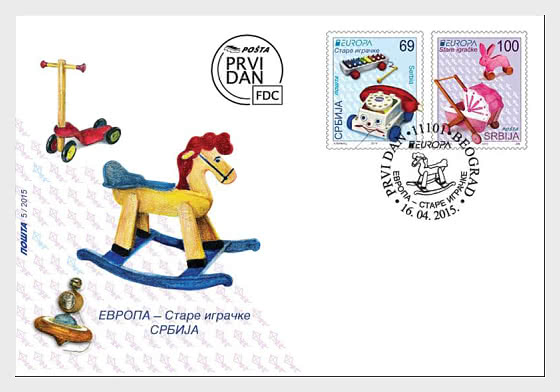
Every object that a child uses to play with can be called a toy. Game is the main children’s activity and an important segment in the period of growing-up and upbringing. In the past, children most often played with the diminished versions of objects from the adults’ world, and that is also the case nowadays. With those toys children were slowly being introduced into their future roles – irons and stoves, dolls and teddy-bears, small pieces of furniture, cars, building bricks, rocking horses...
Besides stimulating and developing children’s imagination, toys are very important educational tools. Diverse skills and intellectual abilities are being developed in the relation between a child and a toy; game stimulates interaction with other children and in that way affects the development of social intelligence. Different games play role in the develpoment of the whole range of abilities: logical-mathematical intelligence, perception of space, shape and their interrelation; knowledge about science and physical forces; about rules and the respect for them; about cooperation, etc. Even the new types of games such as video games, inasmuch as they are propriate and non-agressive, affect children’s development positively – they teach them to be adaptable, to develop imagination, but they are also preparing them for the world of adults which is nowadays greatly affected by computers, technique and technology in general.
Toys exist in every part of the world, they reflect cultures in which they first appeared and they are the product of a certain historical period. Old toys represent social, cultural and economic living conditions of children in the past. By following the develpoment of toys we can also follow the develpoment of technological achievements through historical periods.
Toys were found by archeological excavations of diverse ancient cultures. Historians and archeologists claim that the oldest children’s toys are a flying kite and a spinning top. The history of games is very long; children played for centuries with toys such as balls, spinning tops, dolls, miniature pots, which were made of clay, wood, textile and similar materials. The progress of civilization and of general social conditions led up to the fact that toys have now become available to a greater number of children, thus openning new perspectives for different types of toys as well as for new materials and technologies of production.