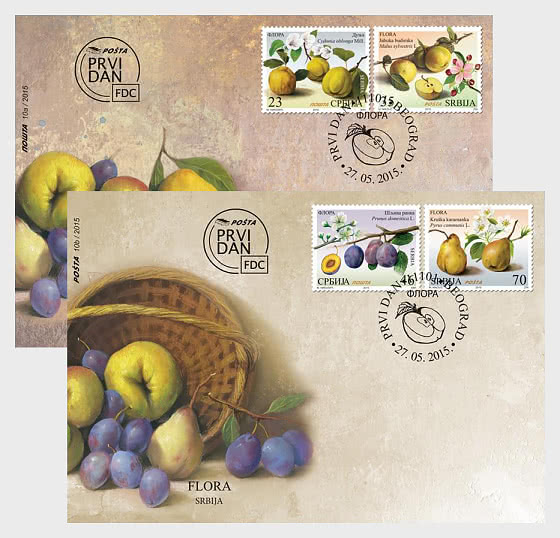
Quince (Cydonia oblonga Mill.)
It is believed that quince (Cydonia oblonga Mill.) has originated in Asia Minor, and via Ancient Greece and Rome it spread further into Europe. Its botanical name stems from the name of Greek city Kydonia (present-day Chania) at Crete. The quince tree is 4-6 m tall, and in Armenia and Iran it may be found in natural populations. Quince fruit is similar to apple and pear fruit. It has high biological value as well as prophylactic and therapeutic significance. The fruits contain a large amount of cellulose, tannin and pectin, so they are rarely used fresh and instead mostly processed (juice, preserves, compote, jelly, jam, brandy). Leskovačka dunja is an old native sort with high-quality fruit. It is farmed in Podunavlje and Pomoravlje (areas around rivers Danube and Morava) as well as in Macedonia and Bulgaria. The fruit is shaped like an apple, up to 400 g in weight, with few stone cells. It is used processed. Vranjska dunja is an old variety of unknown origin, also known as dunjac. It was recorded in vicinity of Vranje. It has very large fruit of pear shape, sometimes up to 500 g in weight. It is used for production of fruit juice.
Apple - The Budim (Malus sylvestris L.)
Budimka is an old domesticated variety, supposedly brought from the East. The tree has a luxuriant crown and may reach old age. Crown is tall and may bear a large yield of fruit. This variety thrives best in moist, well aerated soil. It is resistant to most plant diseases and suitable for organic production. In Serbia, Budimka has been farmed for over 800 years.
Plum - The Early Bird (Prunus domestica L.)
This is an autochthonous variety of our region and one of the best known brandy types of plums, with highest quality. It is believed to have originated in village Darosava near Aranđelovac in Šumadija, leading to its vernacular name darosavka. The tree is of medium stature and with widely pyramidal crown. The brittle branches are easily broken, particularly due to weight of crop yield or due to strong wind. Fruit is small, ellipsoidal, and reddish-blue in color. This variety thrives even on poor, drier soils. It is relatively resistant to fungal diseases and partially susceptible to plum pox virus. Fruit of ranka is eaten fresh or made into jam.
Among the brandy types of plums it is known for high crop yield, while the produced brandy is of top quality. Besides being used for famous slivovitz, ranka plum is a favorite variety mentioned in folk songs, belonging to the oldest original Serbian tradition.
Pear - The Karaman (Pyrus communis L.)
Old, naturalised variety of pear, originated from Asia Minor, from area Karaman. Until the Second World War this was the most common pear variety in the region of Serbia, Bosnia and Macedonia. Presently it is rare, but it still may be found in the catchment valley of Zapadna Morava Region, in Vranje Valley, Toplica, Raška and Metohija.
Fruit is medium-sized, pear-shaped, asymmetrical with characteristic pronounced bumps. The flesh of the fruit is yellowish, melting, juicy and sweet, with characteristic musky smell. It is suitable to be consumed fresh and also for making jam.
It has a healthy and long-lived tree, and the crown has rare branches bent towards the ground, which makes it easy to recognize. This variety is sensitive to sooty scab and fusicladium. It is well suited to moist and fertile soils. It has good yields, and can yield over 200 kg of fruit per season. It ripens in late July, during August and until September, and can be harvested several times.