2015Art - First Day Cover
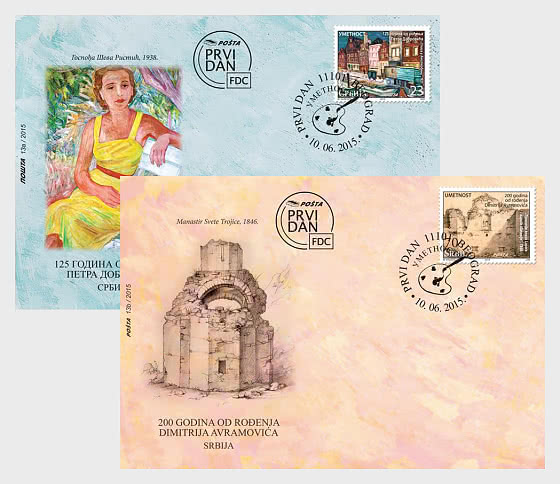
- 10.06.2015
Petar Dobrović (Pécs, Austria-Hungary, 14.01.1890 – 17.01.1942, Beograd, Yugoslavia) was born in the family of the Serbian merchant Petar Dobrović of Pécs, in the then Austro-Hungarian monarchy. He studied painting at the Academy of Fine Arts, Budapest. During his first stay in Paris 1912-1914, his work was influenced by cézanism and cubism, evident mostly in the series of drawings.
Politicaly active, in 1918. he participated in the military mutiny in Pécs, was imprisoned and run away for Novi Sad (Serbia); later on, in the 1921, after his return to Pécs, he became the president of the small and shortlasted (eight days) Baranya-Baya Serbo-Hungarian Republic, in consequence of which he was sentenced to death in absentia. After that event he moves to Belgrade.
From 1927-1930. during his transition art period, Dobrović introduces into his paintings pure color. Third, and the most important period of his art work lasts form 1931-1941, during which he connects highly colorist with expressionist approach: pure color, emphatic gesture, hedonism and modernism.
Dobrović spends his summers on the island of Hvar and in the town of Dubrovnik, where he associates with artists, writers and intellectuals. His main idea was to create “monumental 20th century art”. Following the growth of Serbian and Yugoslav modernism he is the one of the best representatives of the painting of the third decade of constructivist and synthetic painting, and even more, of the forth decade of colorist painting.
From 1923 to 1925 Dobrović lectured at Artistic school in Belgrade. He was one of the founders of State Art Academy in Belgrade (later Fine Arts Academy) and one of the first professors. He also was one of the founders of the modernist art group Oblik (“The Form”). He wrote art reviews in German for the Pariser Deutsche Zeitung, and art critics of Belgrade exhibitions in the daily Politika and the periodical of SKG. At the Kolarac people’s University Dobrović held the figurative paintings course.
He has exhibited in numerous group exhibitions in the country and in Europe, in Paris, Budapest, Prague, Belgrade, Dubrovnik and Venice, and had his first solo exhibition in his hometown of Pécs in 1913. In 1938 he exhibited at the XXI Biennale in Venice. He died in Belgrade on Savindan 1942. He was buried at the New Cemetery.
Graphic realization of the stamp: MA Marina Kalezić academic painter.
Expert collaboration: Žana Gvozdenović, museum advisor.
Museum of Contemporary Art, Petar Dobrović’s Gallery, Belgrade.
200 years since the birth of Dimitrije AvramovićDimitrije Avramović (Saint Ivan Šajkaški, 15 March 1815 – Novi Sad, 1 March 1855) was a painter and a writer, one of the originators of Romanticism in Serbian painting and one of the originators of Serbian caricature. He finished primary and grammar school in Novi Sad, and he studied painting at The Vienna Academy from 1836 – 1840. In Vienna, he belonged to the social circle around Vuk Karadžić, who recommended him as a painter to Prince Mihailo.
Dimitrije Avramović predominantly dealt with visual arts, but at the same time he researched the artistic past and wrote about it for the purpose of historical painting. He visited monasteries in Serbia (Ravanica, Manasija), and in 1847 he travelled to the Holly Mount of Athos.
Dimitrije Avramović travelled to the monasteries of Manasija, Ravanica and to their surroundings in September 1846 with a view to researching and copying the old artistic monuments. He drew four architectural drawings from the collection of the Gallery of Matica Srpska (The Manasija Monastery, The Gate of The Despot’s Inn and The Dining Room of Prince Lazar) outdoors with the intention of faithfully copying the state of what he saw and they represent the oldest document of the expert research of antiquities in Serbia. Avramović’s initiative, which was approved by the then Ministry of Education, is even more important when the complex historical – political circumstances are considered in the Principality of Serbia, dependent on the supreme authority in Constantinopole. Avramović intended to use the material collected during the research for the renewal of the national historical monumental painting. This first journey resulted in the deepening of Avramović’s interest in antiquities. Concluding that the source of the Serbian fresco painting is further to the south, in the spring of 1847 he travelled to Thessaloniki, The Holly Mount of Athos and Constantinopole, and afterwards he published two books on the antiquities of Athos. In the preface of the book The Holly Mount Viewed from the Perspective of Faith, Art and History, Belgrade 1848, thrilled by the national achievements, comparing our cultural heritage with the world’s one, Avramović wrote that even:”....Raphael and Michelangelo and Correggio and Tizian and Rubens and all of the biggest historical fresco painters after them would have gladly been Serbians…” if only they had known about the famous events from the Serbian history.
Besides literal and translation works Avramović also left texts from the field of aesthetics, painting critique, theory and history of art. He died in Novi Sad in 1855.
Graphic realization of the stamp: MA Marina Kalezić academic painter.
Expert collaboration: Milena Vrbaški, museum advisor.
The Gallery of Matica Srpska, Novi Sad.
Serbia - Recommended stamp issues




WOPA+ recommended stamp issues

| Avatar - Fire and Ash |
| Issued: 03.12.2025 |
| ›New Zealand |
| 50th Anniversary of the Founding of the 24th November Bar Scout |
| Issued: 24.11.2025 |
| ›Montenegro |
| Krisjanis Valdemars |
| Issued: 02.12.2025 |
| ›Latvia |

| Sign Language - Good |
| Issued: 02.12.2025 |
| ›Bosnia and Herzegovina - Republic of Srpska |

| In Memory of the Fallen and Murdered on October 7, 2023 |
| Issued: 08.10.2025 |
| ›Israel |

| Annual Collection Folder (New York) |
| Issued: 05.12.2025 |
| ›United Nations |
| Year Set |
| Issued: 24.11.2025 |
| ›Isle of Man |
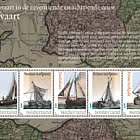
| Shipping in the 17th and 18th Centuries - Peat Shipping |
| Issued: 05.12.2025 |
| ›Netherlands |