Davorin Jenko
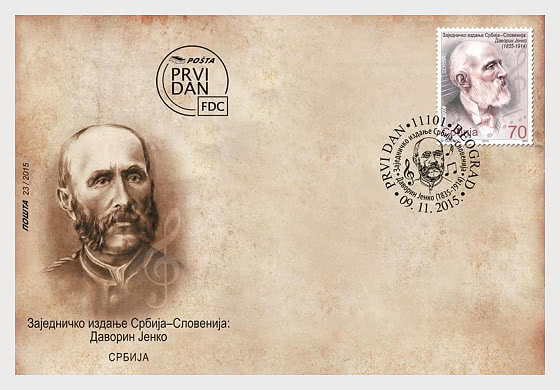
Davorin Jenko (Dvorje, 9 November 1835 – Ljubljana, 25 November 1914) was a famous Slovene and Serbian composer and conductor. Yugoslav by spirit, he was a choirmaster of the Slavic Singing Society in Vienna from 1859 to 1862; at the time he wrote some popular Slovene choral works, among which Naprej, zastave slave later became the national anthem of Slovenia. In the 1860’s he came to Serbia, continuing his work as a choirmaster of the Serbian Church Singing Society in Pančevo, and afterwards inherited Kornelije Stanković as a head of the Belgrade Singing Society. He wrote choral works for the Serbian patriotic poetry. In 1868, when the Royal Serbian Theatre (today’s Serbian National Theatre) was founded, Davorin Jenko was its first conductor. Under the influence of the Serbian musical heritage, he created music for more than 80 plays, among others Đido, The Village Carouser, The Chase, The Sorceress, Pribislav and Božana and several concert ouvertures (Kosovo, Milan, The Serbian Woman, Alexander). He is the author of the music for the Marko’s saber play, by a poet Jovan Đorđević, which was performed in 1872 on the occasion of the accession to the throne of Milan Obrenović, and in which the song Bože pravde, today’s Serbian anthem, was performed.
Davorin Jenko is also a composer of some of the most beautiful old city songs, which are considered to be the folk ones, among others The Reprimand (’De si dušo, ’de si rano), based on the lyrics of Branko Radičević and Tijo noći based on the lyrics of Jovan Jovanović Zmaj. He is deserving of the arrival and engagement of Augusta-Vela Nigrinova, the famous actress. Concertmaster of his orchestra was Petar Krstić, the composer of the music for Koštana, and the cello was played by a poet, Antun Gustav Matoš.
Jenko, a representative of romantic music in Serbia, left his mark on an entire era with his work; he perfected the classic Serbian piece with singing, raised instrumental music to a higher artistic level, and composed the first Serbian operetta (The Witch Doctor or Baba Hrka, premiered in 1882). Together with Stanislav Binicki, he is considered the founder of Serbian opera. He was a member of the Serbian Learned Society (today's Serbian Academy of Sciences and Arts), and for his merits he was awarded the Order of Saint Sava.