2015The British Heroines of the First World War in Serbia - First Day Cover
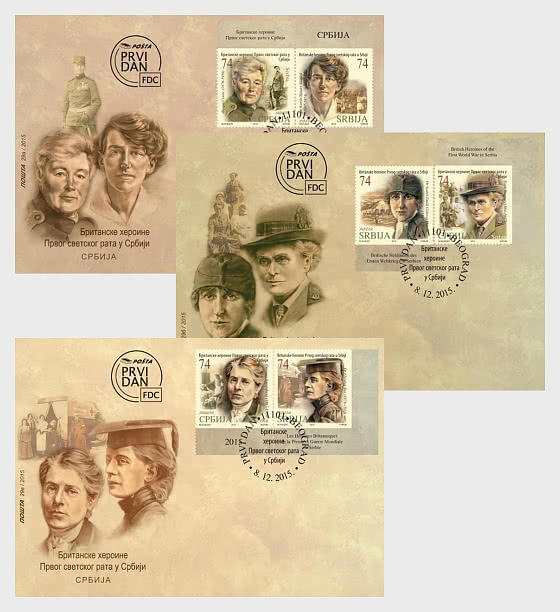
- 08.12.2015
Flora Sandes (Nether Poppleton, Yorkshire, 22 January 1876 – Suffolk, 24 November 1956) was the only female officer of the Serbian army during the First World War and the only woman from Great Britain in the active military service.
When the War started, she voluntarily signed up as a nurse in the Infirmary of Saint John, with which she came to Serbia in August 1914. In Kragujevac she joins the Serbian Red Cross and works as a nurse in the Second Infantry Division of the Serbian army. During the retreat of the Serbian army across Albania, Flora Sands was officially recruited as a soldier and she became the first foreigner in the active service in the then Serbian army.
Together with Milunka Savić she was a member of the “Iron Regiment”. In 1916 she was severely wounded by the enemie’s grenade at the positions near Bitola. Regent Alexander Karađorđević awarded her the Karađorđe Star with Swords and she was promoted into the rank of sergeant. Together with Evelina Haverfield she founded the Serbian Relief Fund. After the War, she was demobilised from the active service in the Serbian army in the rank of captain and continued to live in Serbia. She died in 1956.
Dr. Katherine Stewart MacPhail (Glasgow 1887 – St Andrews 1974), graduated medicine in Glasgow. In January 1915, with the Scottish Women’s Hospital, she arrived to Serbia, Kragujevac, and then proceeded to Belgrade to work at the Military Hospital, Department of Infectious Diseases, with patients suffering from typhoid fever, and Katherine MacPhail herself fell ill as well. After convalescence, as early as spring 1916, she returned to humanitarian work and worked in France, in hospitals where Serbian soldiers were also treated.
After the war, she remained in Serbia and in 1921 she founded the first children’s hospital in our country – English-Serbian Hospital. In 1934 she founded the English-Yugoslav Hospital for Treatment of Osteoarticular Tuberculosis in Sremska Kamenica, which she ran till September 1947. Dr. MacPhail was awarded the Medal of St Sava of the V and IV Order, and for the work in the post-war Belgrade she received the Medal of St Sava of the III Order. She was also awarded the OBE (Order of the British Empire).
Elsie Maud Inglis (Nainitial, 16 August 1864 – Newcastle, 26 November 1917) was a Scottish doctor and the first woman to have been awarded the highest Serbian order – the Medal of the White Eagle. She was also awarded the Medal of Saint Sava.
After the outbreak of the First World War she founded an organization called “Scottish Women’s Hospitals”. In early 1915 she goes to Serbia and establishes the first war hospital. During the retreat of the Serbian army, Elsie Inglis refuses to leave behind the hospital equipment and to retreat with the army, so she gets imprisoned in November 1915 in Kruševac, and afterwards repatriated. She died and was buried in Scotland, and her funeral was attended by the representatives of the Serbian and the Brittish royal families. With her engagement, extraordinary work ethics and personal enthusiasm, she gave a rare example of humanity in the most difficult times and encouraged many other nurses to come to Serbia, the number of which rose to more than six hundred in Serbia in 1915.
Dr. Isabel Emslie Galloway Hutton (1887 – 1960) was a WW1 volunteer since 1915, as a psychiatrist and a member of the Scottish Women’s Hospital. Her unit founded the camp Hospital in Troyes, France, from which Isabel was transferred to Gevgelija (nowadays in Macedionia), from where she quickly retreated to Salonika, to Salonika Front. In summer 1918 she was appointed the Chief Hospital Officer and was transferred to Vranje. She arrived with another 11 physicians and 40 nurses, treating soldiers and civilians in the town where the epidemic typhus and Spanish influenza raged. She remained in Vranje till October 1919 and helped found the local civilian hospital for which she bestowed medical equipment and surgical instruments. She ended her war engagement in 1920, as a commander of a military unit stationed in Belgrade.
For the displayed merits she was awarded the Medal of the White Eagle. Today, the secondary medical school in Vranje bears her name.
Evelina Haverfield (Inverlochy Castle, Scotland, 9 August 1867 – Bajina Bašta, 21 March 1920), was a distinguished women’s rights activist. She came to Serbia in 1915. Together with Dr. Elsie Inglis and other members of of the Scottish Women’s Hospital in Kruševac, she was imprisioned by the occupier together with the wounded.
After the repatriation in 1916 she took part in the organization of the Serbian Relief Fund. In the spring of 1917 Mrs Haverfield unites with three other war veterans, Flora Sands, Emily Simonds and Anna McGlade and establishes the Sands – Haverfield Soup Kitchens which were opened in the Salonika front.
After the liberation she raised a Home for the War Orphans in Bajina Bašta and she helped the tuberculosis patients to be accomodated. She died of pneumonia and was buried in the church yard in Bajina Bašta where, in the memory of her, “The Home – Hospital of Evelina Haverfield” was opened in 1930. Somewhat later, the “Home of Evelina Haverfield” was opened in the curch building.
Evelina Haverfield was awarded the most valuable Serbian medals: the Medal of Saint Sava (IV and V order) and posthumously the Medal of the White Eagle with Swords.
Dr. Elizabeth Ness MacBean Ross (London, 14 February 1878 – Kragujevac, 14 February 1915), a doctor of the Scottish origin, came to Kragujevac, Serbia, in 1915 as a volunteer to treat the severely deseased with typhus.
She is one of the first women with the doctor diploma in Great Britain who came to Serbia as a volunteer. First she went to Niš, then to Kragujevac, which was called the Dead City because of the raging typhus. At the First Reserve Military Hospital at the time of her arrival, there was about 200 patients, and all the doctors and nurses either had already died or were lying among the patients. As Dr. Ross fell down with typhus herself, she worked alone in hard conditions. At the beginning of January 1915 the first unit of the Scottish Women’s Hospital came to Kragujevac, so the staff of the Scottish Women’s Hospital helped their compatriot. After 13 days of fighting typhus fever Dr. Elizabeth Ross died on 14 February 1915 on her 37th birthday. Dr. Elizabeth Ross was buried with full military honours at the cemetery in Kragujevac.
Serbia - Recommended stamp issues



WOPA+ recommended stamp issues

| Avatar - Fire and Ash |
| Issued: 03.12.2025 |
| ›New Zealand |
| 50th Anniversary of the Founding of the 24th November Bar Scout |
| Issued: 24.11.2025 |
| ›Montenegro |
| Krisjanis Valdemars |
| Issued: 02.12.2025 |
| ›Latvia |

| Sign Language - Good |
| Issued: 02.12.2025 |
| ›Bosnia and Herzegovina - Republic of Srpska |

| In Memory of the Fallen and Murdered on October 7, 2023 |
| Issued: 08.10.2025 |
| ›Israel |

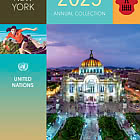
| Annual Collection Folder (New York) |
| Issued: 05.12.2025 |
| ›United Nations |
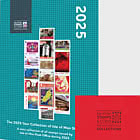
| Year Set |
| Issued: 24.11.2025 |
| ›Isle of Man |
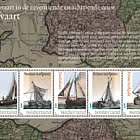
| Shipping in the 17th and 18th Centuries - Peat Shipping |
| Issued: 05.12.2025 |
| ›Netherlands |