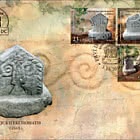
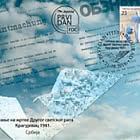
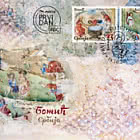
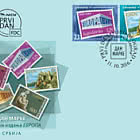
201623rd International Congress of Byzantine Studies – Belgrade 20 - First Day Cover
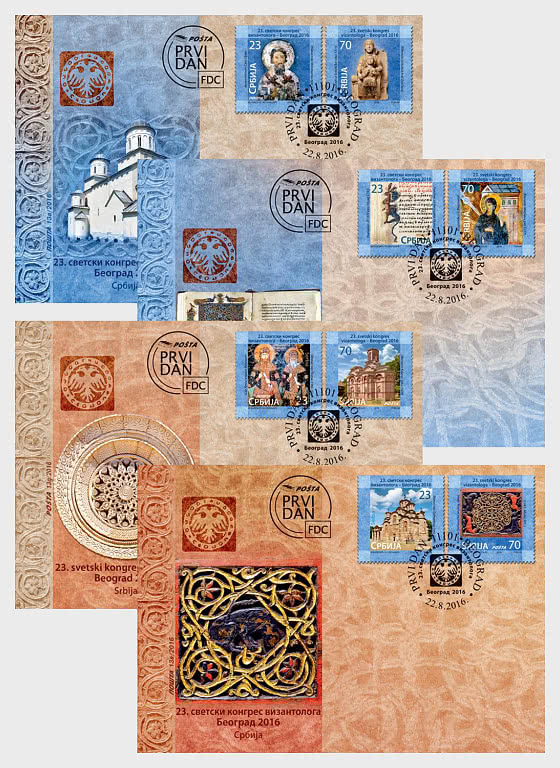
- 22.08.2016
- MA Marina Kalezić, academic painter and MA Nadežda Skočajić, academic painter – graphic artist
The capital of Serbia will host, from 22nd until 27th of August this year, for the second time, the most eminent scientists and researchers who deal with the history of Byzantium in all its aspects. The first time was in 1927, when the Second World Congress of Byzantologists was held in Belgrade. The Congress, with the help of the International Association of Byzantine Studies, is organized by the Serbian National Committee led by the academician Ljubomir Maksimović.
Georgije Aleksandrovič Ostrogorski (1902, Saint Petersburg – 1976, Belgrade), is one of the founders of Modern Byzantology in Serbia and worldwide, and a writer of the unexcelled synthesis on a thousand years history of Byzantium. He left his country in the midst of the October Revolution and continued his studies in Heidelberg and Paris. He comes to the Chair for Byzanto-logy of the Belgrade University in 1933 and teaches there until his retirement in 1973. He became a member of the SASA in 1946. He founded the Institute for Byzantine Studies at the Serbian Academy of Sciences and Arts (SASA) in 1948, whose director he was until death. With the help of his associates, he organized the 12th International Congress of Byzantologists, which was held in 1961 in Ohrid.
Sava, the first Serbian archbishop (Mileševa monastery, before 1227). The oldest portrait of Sava was painted in his lifetime. He was painted beside his father, Saint Simeon, on the north part of the east wall of the old narthex, and in front of his elder brother, Stefan the First-crowned and the two of his sons - Radoslav and Vladislav. After he consolidated the independence of the Serbian Church during the 3rd decade of the 13th century, Sava pilgrimaged twice the holy places of the East, near the end of his life, in 1229 and 1234/5. On his way back from the second journey, he dies in early 1236 in the Bulgarian capital Trnovo.
Mother of God of Sokolica (around 1315). A marble sculpture of the Mother of God on a throne with the little Christ in Her lap, is the biggest shrine of Sokolica monastery near Zvečan. In the beginning, it adorned a lunette of the western entrance of the temple of Saint Stefan the Archdeacon and Protomartyr in Banjska. The church was built on the model of Studenica, with facades of multi-coloured marble and rich plastic decoration in which, for the last time in the Serbian medieval art, a particular blend of the Byzantine and Romanic art was achieved. The founder, King Milutun, prepared a tomb for himself within the church and was buried there. Of the former iconography, whose gold background is praised by the later chroniclers, only the fragments remain today.
The initial “V” (the second half of the 14th century). A skillful miniaturist created a letter V from an eagle and a lion who attack a rabbit. The initial is in the manuscript with sermons of Isaac Sirin, on a verso 200 sheet. The manuscript is still kept today in the collection of the Museum of the Serbian Orthodox Church in Belgrade.
Mother of God from the Annunciation (Mileševa monastery, before 1227). The monastery with a church which is dedicated to the Ascension of Our Lord Jesus Christ, is the endowment of the younger son of Stefan the First-crowned, Vladislav. The founder, being the Serbian king, translated the relics of his uncle, Saint Sava, from the Bulgarian capital Trnovo, where the first archbishop of the Serbian Orthodox Church passed away in 1236. The frescos of Mileševa represent the highest achievements in the European painting of their time. The monastery was the second in rank in the Middle Ages among Serbian monasteries, right after Studenica monastery.
Gračanica monastery (around 1315). The five-dome Church of the Annunciation is one of the masterpieces of the Serbian medieval art. It was built and decorated inside with iconography with the resources of the King Stefan Uroš II Milutin and it was the seat of the bishops of Lipljan. The emphasized verticality makes it different from the architecural achievements of that time and makes it unique not only in the Serbian medieval architecture, but also in the Byzantine world, where it belongs according to the way of building. In the interior of the church, one of the most extensive painting programmes was preserved. It has its closests parallels, according to the style characteristics, in the best achievements of fresco painting of the Palaeologus age.
The sarcophagus of Saint Stefan Dečanski (a detail, 1343). Surely, the most valuable piece of the Serbian medieval carving, precisely dated and very well preserved. After 12 years of Stefan Dečanski’s death, his incorrupt relics were taken out from the sepulchre under a bigger sarcophagus in the southwest part of the nave of Dečani and it was laid in a new wooden sarcophagus. This happened in the spring or summer of 1343, and since then his relics have been available for the veneration of believers. The basic motif is a herbal brier turned into a geometrical interweaving, with the emphasized polychrome of the entire sarcophagus. The middle fields of the longer sides are additionally ornamented with two pairs of adorned red and green lions.
Emperor Uroš and King Vukašin (Psača monastery, 1366-1371). In Saint Nicholas church, which was built by the father and son, Prince Paskač and Sebastocrator Vlatko, near Kriva Palanka on the territory of today’s Macedonia, the ruler – the last of the Nemanjić dinasty in the Serbian territories, Dušan’s son and the second Serbian emperor, Uroš, and his coruler – the most influential grandee at his court, Vukašin, whom Uroš declared coruler and crowned him king, are represented together. Both of them ended their lives in 1371 – Vukašin died in the battle against the Turks on the river Marica on September 26th, and Uroš died a few months later.
Kalenić monastery (around 1420). This monastery, dedicated to the Entry of the Mother of God into the Temple, in Levač, is the last pearl of the Serbian medieval construction and painting. The founder was the protovestiarios Bogdan, in charge of the state treasury in the last decade of the reign of Despot Stefan. Picturesque facades of this small church of a triconchal basis represent the peak of the final and at the same time the most original phase in the Serbian medieval architecture which developed in the age of Prince Lazar and his son Despot Stefan. The frescos in the temple are characterized by the refinement of pastel colours and the sublimity of the characters who are freed from the then dramatic everyday life which was overcast by the necessity of the Turkish conquest.
Serbia - Recommended stamp issues



WOPA+ recommended stamp issues

| Avatar - Fire and Ash |
| Issued: 03.12.2025 |
| ›New Zealand |
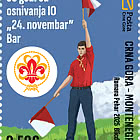
| 50th Anniversary of the Founding of the 24th November Bar Scout |
| Issued: 24.11.2025 |
| ›Montenegro |
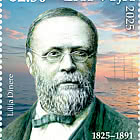
| Krisjanis Valdemars |
| Issued: 02.12.2025 |
| ›Latvia |
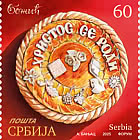

| Sign Language - Good |
| Issued: 02.12.2025 |
| ›Bosnia and Herzegovina - Republic of Srpska |

| In Memory of the Fallen and Murdered on October 7, 2023 |
| Issued: 08.10.2025 |
| ›Israel |

| Annual Collection Folder (New York) |
| Issued: 05.12.2025 |
| ›United Nations |
| Year Set |
| Issued: 24.11.2025 |
| ›Isle of Man |
| Shipping in the 17th and 18th Centuries - Peat Shipping |
| Issued: 05.12.2025 |
| ›Netherlands |