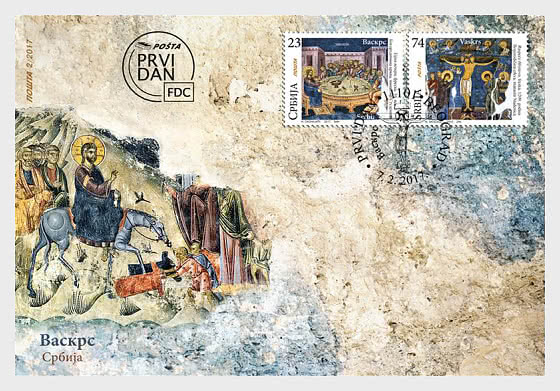
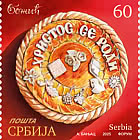
Easter is one of the most important Christian holidays and a movable feast. It is a day of eternal joy, the day when Christ, the Son of God, conquered death. By the act of resurrection, Jesus Christ proved his divine powers and opened the door to eternal life, joy, and happiness that can be found in our faith. On Easter Sunday the church bells ring and the people, together with their priest, walk around the church. After the third round, they all stop in front of the church. The priest carries a cross, a candle, and an thurible, and he sings the Easter liturgy. The doors open and the people go into the church where the liturgy continues. When it is over, the people greet each other with: “The Christ has resurrected”, “Indeed he has”. There are many customs related to Easter Sunday, but the one that children certainly love the most is dyeing and sharing of the eggs. The first egg is coloured in red and in many parts of our country this egg is called “The House Keeper” and it is kept throughout the whole year, until the next Easter.
This year’s commemorative issue „Easter” displays frescoes from the Church of the Virgin from the Studenica Monastery. 1986, and within the monastery complex are the Church of the Virgin, built in the distinctive Raška School of eastern medieval church architecture, founded by Stefan Nemanja (after 1183) with narthex by King Radoslav (1234), the Church of St. Nicholas, King’s Church of St. Joachim and Anne, foundations of the Church of St. John the Baptist, dining room, dormitory, and the Treasury. Church of the Virgin was painted in 1208/9, but only a small number of unchanged compositions were preserved, while a significant number of them was later altered during the restoration. The fresco “Crucifixion of Christ” created in 1209 is classified as one of the pieces with the highest artistic achievement, while the frescoes “Palm Sunday” and “The Last Supper” belong to a later period.